Exhibition preview·Global
Pneuhaus's walk-in inflatable Compound Camera 3 turns 221 camera obscuras into a sun-powered projection
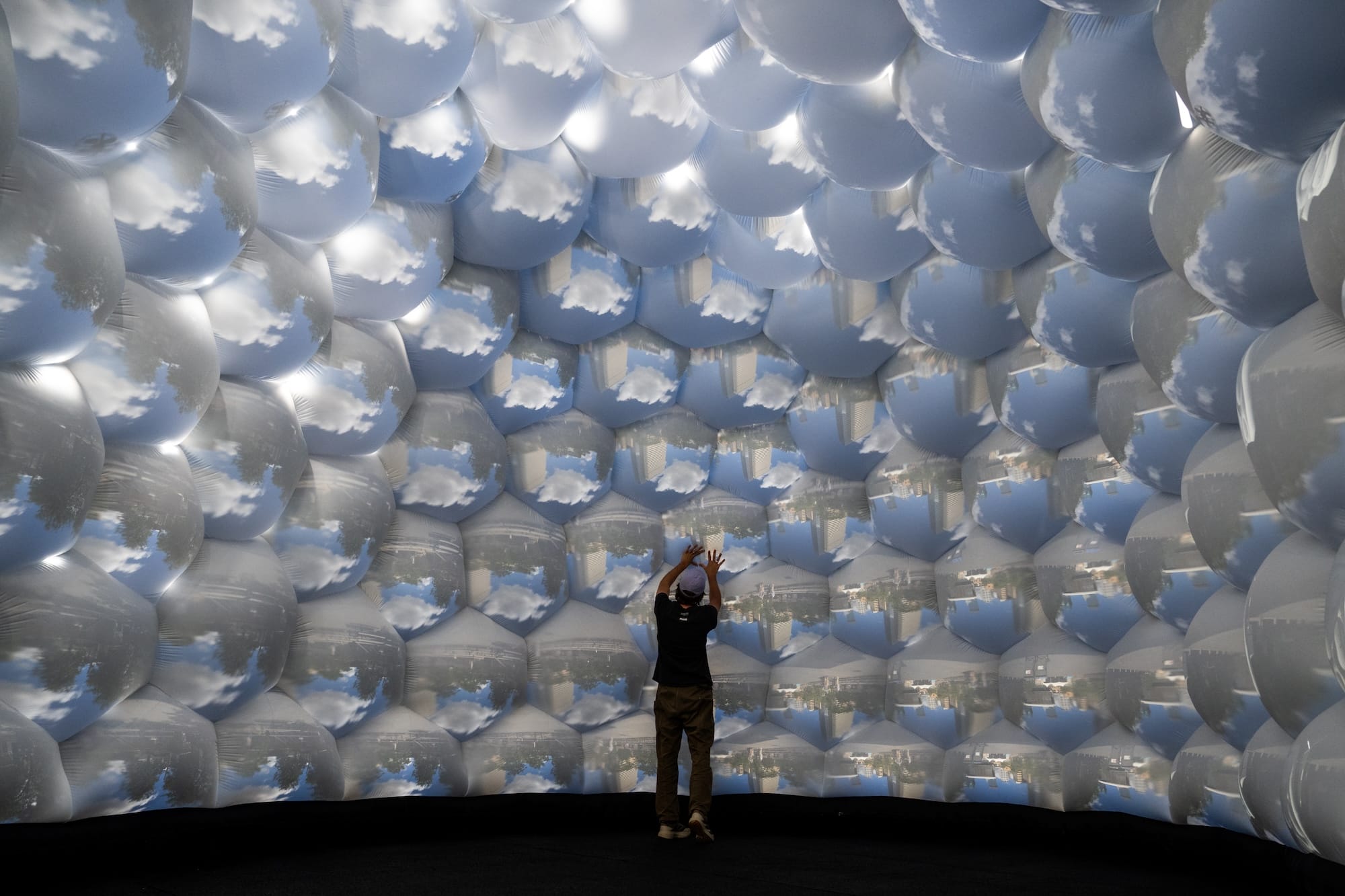
Rhode Island studio Pneuhaus premiered 'Compound Camera 3' — a walk-in inflatable installation studded with 221 lenses functioning as camera obscuras — at September's MODE Festival: covering 700+ sq ft, the sun-powered structure projects the sky and surroundings onto bulbous interior surfaces that visitors can push to distort the view.
The Rhode Island-based studio Pneuhaus, known for large-scale architectural inflatables, has unveiled its most ambitious optical work to date. Compound Camera 3 premiered in late September at MODE Festival, a celebration of global photography: a walk-in inflatable structure studded with 221 lenses, each functioning as a camera obscura, spread across more than 700 square feet. Visitors enter the structure and find themselves inside a projection powered entirely by the sun. Upward-facing lenses throw images of the sky onto the bulbous interior membranes, while sideways apertures capture trees, buildings, and passersby. The soft material is part of the instrument: visitors can push against the walls to distort the projected image, producing what the studio describes as a bug's-eye view of the surroundings. Nothing is recorded; the image exists only for as long as someone stands inside it. The work extends a lineage of camera-obscura experiments that stretches back to the Renaissance, but its scale and sociability are new. Where the historical camera obscura was a solitary, darkened room, Compound Camera 3 is a collective, luminous one — a piece of public art that turns its audience into both viewers and, momentarily, into the image itself. For Pneuhaus, the installation continues a practice of treating inflatables as serious architectural and optical media rather than novelty structures. For festival audiences, it offered something increasingly rare in photography culture: an image that cannot be screenshotted, saved, or shared — only experienced, in person, in sunlight. The studio, which premiered the work at MODE Festival's celebration of global photography in late September, describes the 700-plus-square-foot structure as its largest optical environment yet.