Museum report·Tokyo
Idemitsu Museum Marks 60th Anniversary With First Full Unrolling in a Decade of the National Treasure 'Ban Dainagon' Scrolls
Tokyo University of the Arts' museum will show all three scrolls of the 12th-century National Treasure 'Ban Dainagon Emaki' for the first time in ten years, as the centerpiece of the Idemitsu Museum of Arts' 60th-anniversary exhibition opening in March 2027.
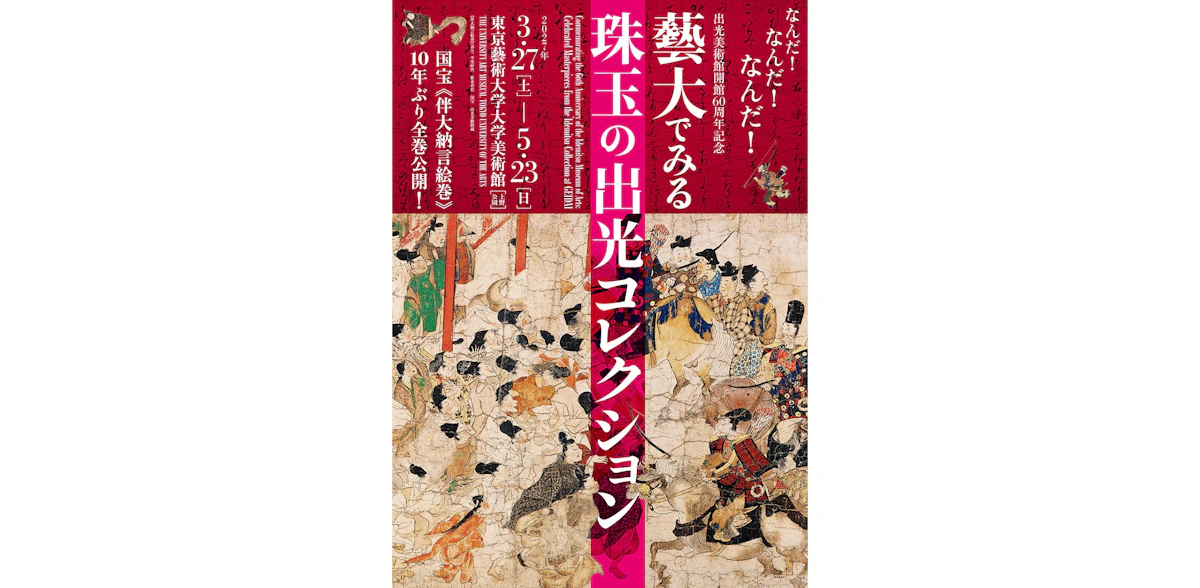
One of Japan's most celebrated painted handscrolls will be unrolled in full for the first time in ten years. The Idemitsu Museum of Arts, which opened in 1966, is marking its 60th anniversary with an exhibition at the Tokyo University of the Arts' University Art Museum, running March 27 to May 23, 2027, that draws a selection of Japanese and East Asian works from its holdings. The undisputed anchor of the show is the National Treasure 'Ban Dainagon Emaki,' a 12th-century emaki whose three scrolls will be displayed together. The scrolls narrate the burning of the Otenmon gate in 866 and the downfall of the courtier Tomo no Yoshio, who plotted the arson. Crowds of onlookers, officials, and investigators move through the story in a continuous sequence of scenes, and the work is prized as much for its vivid crowd depictions as for its value as a record of court life. The Idemitsu Museum notes the possibility that the court painter Tokiwa Mitsunaga, favored by the retired emperor Go-Shirakawa, played a leading role in its production. Around the scrolls, the exhibition traces the formation of the Idemitsu collection itself, rotating works between an early and a late phase. The lineup spans medieval to Edo-period Japanese art and includes Ito Jakuchu's 'Birds, Animals and Flowering Plants' folding screen from the 18th century alongside works by Sengai Gibon, Sakai Hoitsu, Kitagawa Utamaro, and Suzuki Kiitsu. Because the full scrolls have not been shown together for a decade, the 2027 display will be a rare chance to see the complete narrative unfold in sequence. The exhibition presents it as both an art-historical landmark and a window onto how one of Japan's great private collections of classical art took shape.