Museum report·Manchester
Eight artists weave India and Korea together at Manchester's Whitworth in textile show
The Whitworth's Hyundai Translocal Series: Entangled and Woven, on view until 3 January 2027, pairs four Indian and four South Korean artists whose textile commissions grew out of research exchanges in each other's countries, shown alongside collection pieces that complicate the materials' colonial histories.
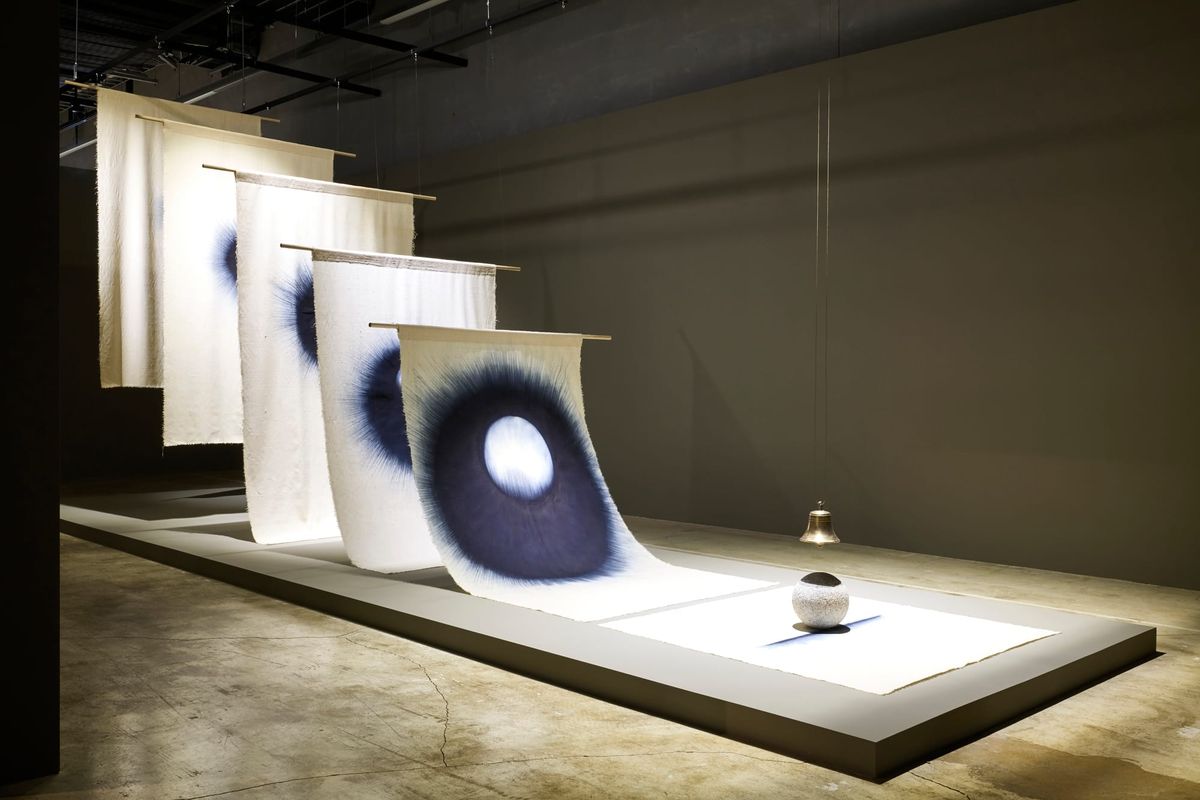
Eight artists from India and South Korea have spent months learning each other's craft traditions, and the results are on show at the Whitworth in Manchester until 3 January 2027. Hyundai Translocal Series: Entangled and Woven pairs four artists from each country, all of whom developed textile commissions after research trips to one another's countries, and sets their work against pieces from the museum's own collection.
The Odisha art-and-fashion collective Boito contributes a sculpture of the Navangunjara, the nine-animal chimera that confronts the warrior Arjuna in a fifteenth-century Odia retelling of the Mahabharata. Each part of the creature stands for a local craft: its peacock neck is covered in cloth-based pattachitra painting, while plaited sabai grass forms its serpent tail. Yeonsoon Chang's Worincheongang series, whose title translates as the moon reflected on a thousand rivers, sews and irons indigo-dyed abacá fabric into near-prismatic structures that catch light like moonlight on water.
Indigo runs through the show as both colour and history. Kaimurai paints dense radial lines in the pigment, which the artist regards as sacred, while a fragment of nineteenth-century indigo resist-dyed cotton from the Whitworth's holdings recalls the era when European demand for 'blue gold' pushed Indian farmers to grow indigo instead of food — a pressure that ended in the Indigo Revolt of 1859. Sumakshi Singh's lace recreation of a bridge in Cheongju and Jounghye Yoo's layered fabrics cut to the shape of a Varanasi temple gate extend the show's interest in sacred architecture.
The closing works turn to women's labour. Péro's Entangled Memories, Interwoven Stories is built entirely from the stitching normally used to finish seams and raw edges in clothing, echoing the lattice screens of Mughal palaces and a Chikankari mat from the collection — a white-on-white embroidery tradition that faded under British rule and survived as domestic work passed between women. Young In Hong's flags, made with the Kala Raksha collective in Kutch, celebrate embroidery and mirrorwork as markers of community identity.