Exhibition preview·Tokyo
TOKYO ATLAS opens on Tokyo's waterfront with Yayoi Kusama's final large-scale work
TOKYO ATLAS, the first international art exhibition staged on Tokyo's waterfront, opened October 10 across Odaiba, Aomi and Tennozu with free admission through December 20. Its centerpiece pairs two of Yayoi Kusama's monumental balloon sculptures for the first time in Japan in what is billed as her last coordinated project.
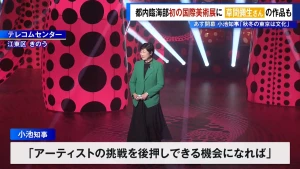
Tokyo has launched its first international art exhibition on the waterfront. TOKYO ATLAS opened on October 10 across the bay areas of Daiba, Aomi and Tennozu, and will run 72 days through December 20, 2026. Organized by the Tokyo Metropolitan Government, the Tokyo Metropolitan Foundation for History and Culture and the Executive Committee for the Tokyo International Festival of Arts and Culture, with artistic direction by Miki Akiko and Tatehata Akira, it is the flagship of ARTE TOKYO, the city's new inaugural autumn arts festival running October 10 to December 31. Venues include Daiba Park, Odaiba Marine Park, the Telecom Center Building, Isle Shinagawa, WHAT MUSEUM, and Aomi Minami Port Park — including the park's underground parking lot, built for the cancelled 1995 World City Expo and left unused for three decades, now opened to an art event for the first time. Admission is free, with organizers targeting 500,000 visitors, including 30,000 from overseas. Tokyo Governor Yuriko Koike declared the exhibition open at a ceremony on October 8, saying she hoped it would support artists' creative challenges. The emotional centerpiece is a landmark installation by Yayoi Kusama at the Telecom Center Building atrium: her monumental balloon sculptures Yayoi-chan and A Bouquet of Love I Saw in the Universe are shown together for the first time in Japan. The project is billed as the artist's last coordinated work; Kusama died in August 2026. French artist Abraham Poincheval contributes La Bouteille, a performance in which he inhabits a giant bottle, while the collaborative initiative Goat's Eyes transforms part of the working waterfront into a participatory environment examining sustainable creativity. Other participants include Zhao Yao, Leiko Ikemura, Haroon Mirza and Keita Mori. Drawing on the double meaning of its title — the mythological Atlas and an atlas of maps — the exhibition asks visitors to follow the routes the artworks lay out and read Tokyo afresh. Daiba Park, originally built as an Edo-period coastal battery, offers a striking backdrop where contemporary art meets one of the symbolic gateways to Japan's modernization, grounding the new festival in the history and geography of the waterfront.