Exhibition preview·Global
Tiny Alien Worlds on Oak Leaves: Timothy Boomer's Close-Ups of Insect Galls
Nature photographer Timothy Boomer turns his macro lens on the strange, jewel-like growths that gall wasps induce on California oaks, using focus-stacking to reveal structures the naked eye can barely see.
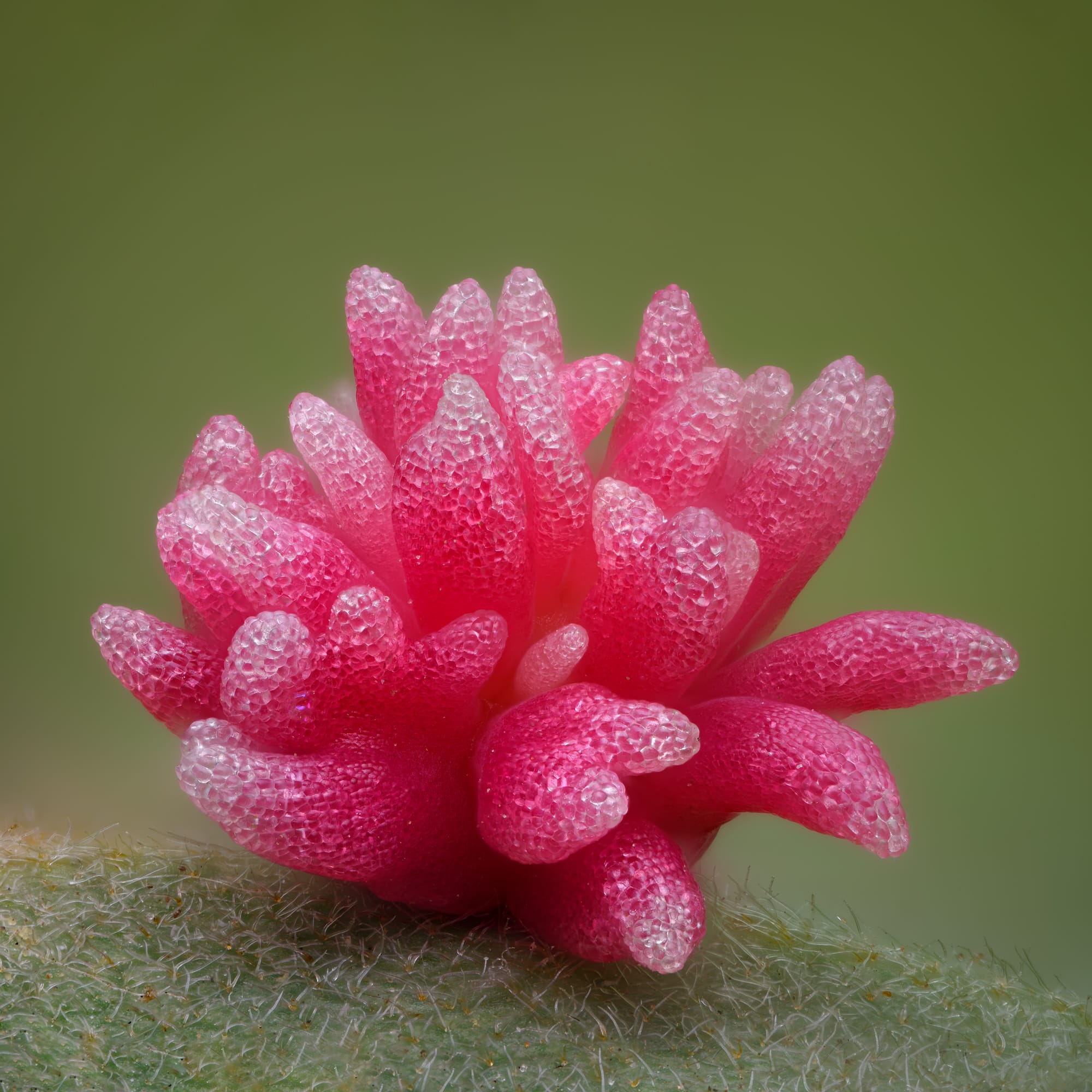
Nature photographer Timothy Boomer has turned his attention to one of the natural world's strangest small phenomena: the galls that wasps induce on oak trees. Working in Solano and Napa counties in California, he photographs the tiny growths at extreme close range, revealing spiked, jewel-like forms in pinks, reds and yellows that look more like alien organisms than plant tissue.
Galls form when a gall wasp, also known as a cynipid, lays eggs in a host plant and its larvae release chemicals that redirect the plant's resources. The resulting growth shelters the developing insect and feeds it until it emerges as an adult. Different wasp species produce distinct shapes, often on very specific parts of a tree, and scientists believe there are at least 1,300 cynipid species worldwide.
Boomer focuses on the most visually striking examples. His subjects include the urchin gall wasp on blue oak, the striped volcano gall, the spined turban gall and the woollybear gall, each photographed where it grows in the wild around Vacaville and Lake Berryessa. He also documents cases where development goes wrong: one spined turban gall, normally bubblegum pink, grew dark with blackened spikes after another organism entered it early, an intrusion Boomer likens to a home invasion that alters the home.
Because the galls are minuscule and the depth of field is shallow, Boomer uses focus-stacking, layering hundreds or sometimes thousands of frames into a single sharp image. He edits as little as possible in Photoshop, preferring to show only what occurs naturally. As he puts it, nature does not need to be enhanced.