Museum report·Amsterdam
Microbes Are Living on Rembrandt's Night Watch — and Scientists Say They May Unlock Its Secrets
Amsterdam's Rijksmuseum has teamed up with the city's zoo and microbe museum to study the invisible life living on Rembrandt's Night Watch, with the first findings now on show in a new exhibition at ARTIS-Micropia.
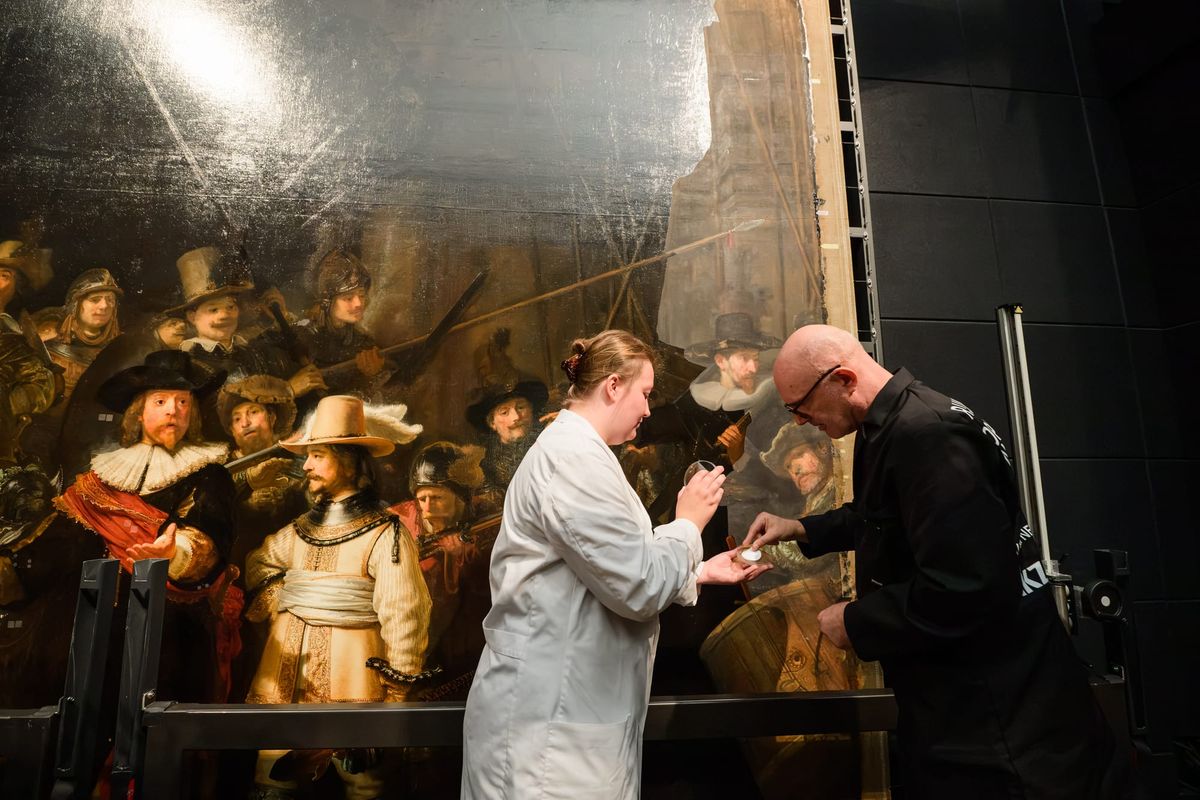
In the Rijksmuseum's Gallery of Honour, where Rembrandt's Night Watch of 1642 holds pride of place, a microbiologist in a white coat has been taking samples from the canvas and placing them in Petri dishes. The work is part of a partnership between the Amsterdam museum and ARTIS-Micropia, the zoo's museum devoted to microbes, and the early results are now on display in The Night Watch Lives, which opened at ARTIS-Micropia on 11 November.
A life-size reproduction of the painting hangs in the exhibition, marked with numbers and dates showing where each sample was taken, while glass cases hold the Petri dishes themselves. Twenty bacterial findings are on show so far, with ten more still incubating and awaiting identification. Six sampling trips to the Rijksmuseum are planned, three of which have already happened, and the project leaders expect around sixty microbes to be identified in total. The installation will keep growing until February and remain on view until the end of May.
Among the first discoveries were soil bacteria and familiar skin bacteria, but one find stood out: Microbacterium saccharophilum, a species first identified at a sugar refinery in Japan. Nobody knows how, or when, it reached a Dutch canvas. The museum says this is the first time microbial research of this kind has been carried out on a work of art. The study runs alongside Operation Night Watch, the vast restoration and research programme launched in 2019, during which scientists in 2023 found a rare lead compound beneath the painting's primer, possibly applied by Rembrandt to protect the canvas from mould. Restorers are currently removing old varnish layers, a process visitors can watch live behind glass.