Museum report·London
25 Piero masterpieces head to London as National Gallery plans its largest show devoted to the Renaissance painter
The National Gallery in London will stage the largest exhibition ever devoted to Piero della Francesca in autumn 2027, bringing together around 25 paintings and manuscripts including the Urbino Diptych from the Uffizi and the complete Perugia Altarpiece.
London's National Gallery has announced what it bills as the most ambitious survey yet of Piero della Francesca, the fifteenth-century Italian painter whose mastery of geometry and light made him one of the Renaissance's most quietly radical figures. The exhibition, scheduled to run from 2 October 2027 to 30 January 2028, will assemble around twenty-five paintings and manuscripts drawn from collections across Europe and the United States.
Among the loans, the centrepiece arrivals include the paired portraits of Federico da Montefeltro and Battista Sforza, known as the Urbino Diptych, travelling from the Uffizi in Florence, and the complete Perugia Altarpiece of 1468 from the Galleria Nazionale dell'Umbria. The Clark Art Institute in Massachusetts is lending a Virgin and Child Enthroned with Four Angels dated to about 1460-70. A digital presentation of the Legend of the True Cross fresco cycle in Arezzo will stand in for the wall paintings that cannot travel.
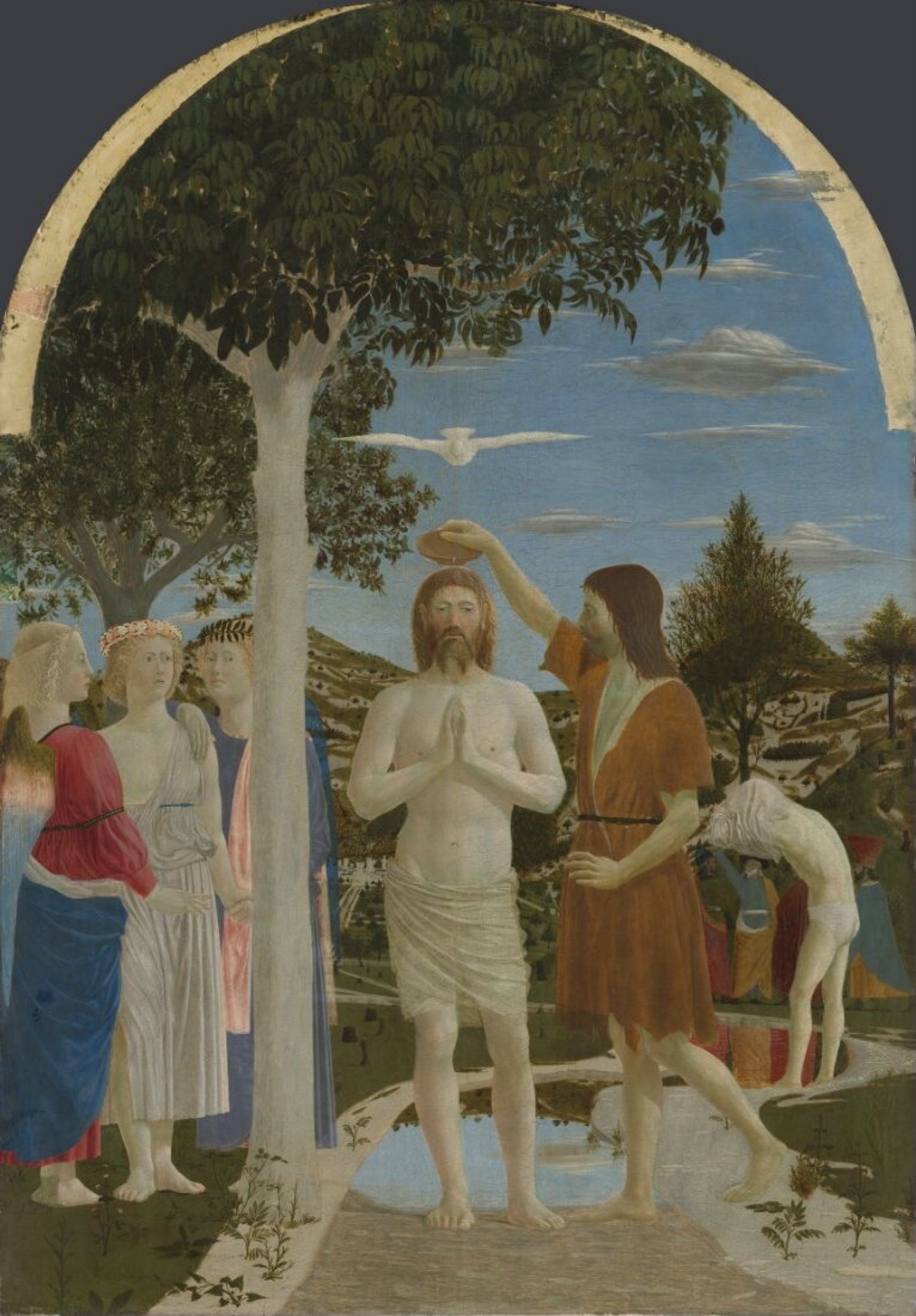
Three pictures already owned by the gallery will anchor the hang: the Baptism of Christ from the late 1430s or early 1440s, Saint Michael of 1469, and the Nativity from the early 1480s. Together they trace a career in which Piero treated painting as a branch of mathematics, writing the first treatise on perspective and building his compositions from measured space, stillness and carefully graded colour.
The show is being organised around seven qualities the gallery identifies as defining Piero's art: colour, design, space, perspective, narrative and light. It will be co-curated by Laura Llewellyn, the gallery's curator of Italian paintings before 1500, together with Machtelt Brüggen Israëls of the Rijksmuseum and the University of Amsterdam. The previous benchmark for a Piero gathering was a Hermitage show in 2018 that managed just eleven works, a measure of how rarely these fragile panels are allowed to travel.