Exhibition preview·London
At the Barbican, Lawrence Abu Hamdan Turned Sound Into Evidence of War and Occupation
Lawrence Abu Hamdan's four-day Barbican takeover presented Zifzafa, a livestreamed audio essay on a wind farm in the occupied Golan Heights, and Air Pressure, on the sonic occupation of Lebanon, alongside Rana Eid and Matthew Herbert's Sykes-Picot performance.
A four-day takeover at the Barbican in London asked what constitutes a sonic crime and what we have made inaudible. Part of the venue's Repercussions series, produced between 23 and 26 September, artist Lawrence Abu Hamdan presented a video installation and a live performance-lecture exploring aural injustice in West Asia and its echoes in Britain.
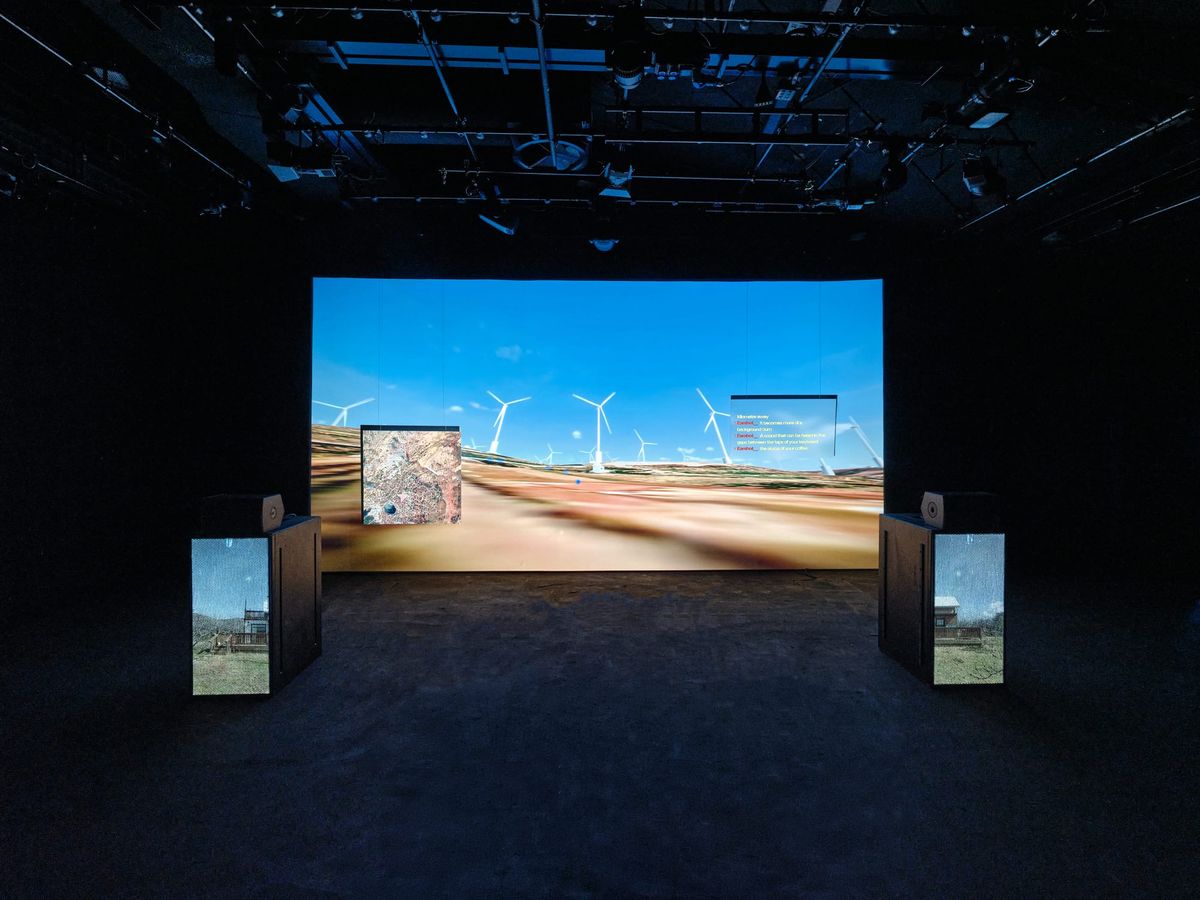
Zifzafa: A Livestream Audio Essay, made in 2025, stages a virtual flyby across the Israeli-occupied Syrian Golan Heights with narration unfolding in a chat box. It investigates the near-deafening fallout surrounding the construction of a wind farm there by Israeli company Energix, layering audio clips of Jawlani village life and animal activity that double as an archive of an endangered soundscape. Air Pressure, from 2022, shifted focus to Lebanon, drawing on social media footage to recount how the din of Israeli Defence Forces aircraft trespassing Lebanese airspace became the score structuring daily life during the country's rapid unravelling in 2020 and 2021.
Abu Hamdan traced how silence is never neutral: he described the Lebanese skies falling quiet in May 2021 as airstrikes began on Gaza, and how Jawlani activists protesting the wind farm were unexpectedly joined by the Israeli environmentalist group Keepers of the Golan, whose concern was preserving the land's tranquillity. He also noted how 20 countries have funded arms manufacturer Lockheed Martin's F-35 fighter jets, with Israel operating its own software for the aircraft.
The programme continued with Sykes-Picot, a new commissioned performance by Rana Eid and Matthew Herbert tracing the spectres of the British and French diplomats whose 1916 agreement carved up the Ottoman Empire. Having planned to use archival audio from the diplomats' lifetimes, the artists pivoted after the archivist they were working with was killed in Lebanon this April and the archive destroyed, recording instead the places where the two men lived and worked.