Exhibition preview·New York
50 Years On, Claes Oldenburg's Six Themes Return to New York at Paula Cooper Gallery
Paula Cooper Gallery's Six Themes, opening November 5 and running through December 19, reunites the half-dozen motifs Oldenburg explored from the 1970s onward for the first time since the landmark 1975 Walker Art Center survey.
Claes Oldenburg's most enduring subjects are coming back together in New York. Paula Cooper Gallery will open Six Themes on November 5, an exhibition devoted to the six motifs the artist, who died in 2022, explored in depth from the 1970s onward: Geometric Mouse, Three-Way Plug, Fagends, Clothespin, Typewriter Eraser and Standing Mitt with Ball. The show continues through December 19.
The title takes its name from the landmark survey staged at the Walker Art Center in 1975, which afterwards travelled to the Denver Art Museum, Seattle Art Museum, New Orleans Museum of Art and the Art Gallery of Ontario in Toronto. The new exhibition is the first time the seminal pieces have been celebrated collectively since that tour, five decades ago, and includes significant works representing each of the half-dozen subjects, among them rarely seen examples from the artist's estate and private collections.
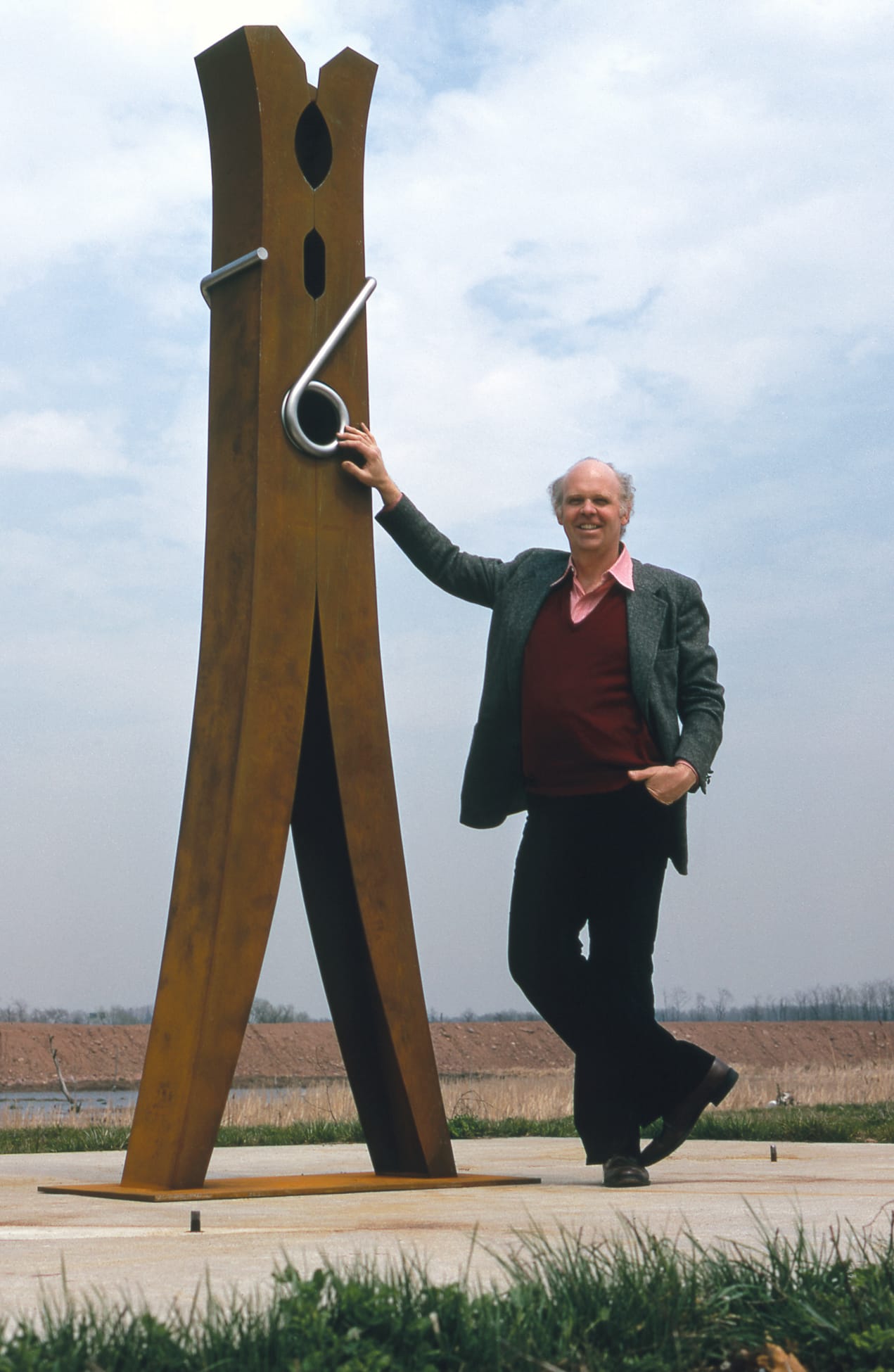
Oldenburg built his reputation on taking everyday objects and ramping them up to monumental scale. His Philadelphia Clothespin of 1976 towers over Center Square Plaza, while Spoonbridge and Cherry, made in 1988 with his wife and collaborator Coosje van Bruggen, has pride of place over a pond in the Minneapolis Sculpture Garden. Big Sweep of 2006 shows a broom whisking crumpled paper into a dust pan at the Denver Art Museum, and Typewriter Eraser, Scale X from 1998 to 1999 depicts a giant vintage eraser with its small attached brush in Washington's National Gallery of Art Sculpture Garden.
The artist insisted that any subject be extremely adaptable in scale, so that a small clothespin would be as interesting as one a hundred feet high. He worked in soft prototypes too, sewing stuffed-canvas versions of his hard-edged icons. The exhibition arrives 65 years after his 1961 statement I Am For, the 700-word paean he later called a slightly satirical ode to using anything in one's surroundings as a starting point for art.