Exhibition preview·London
Studio DRIFT lets London visitors conduct light itself in wind-themed 'Aeolus' installation
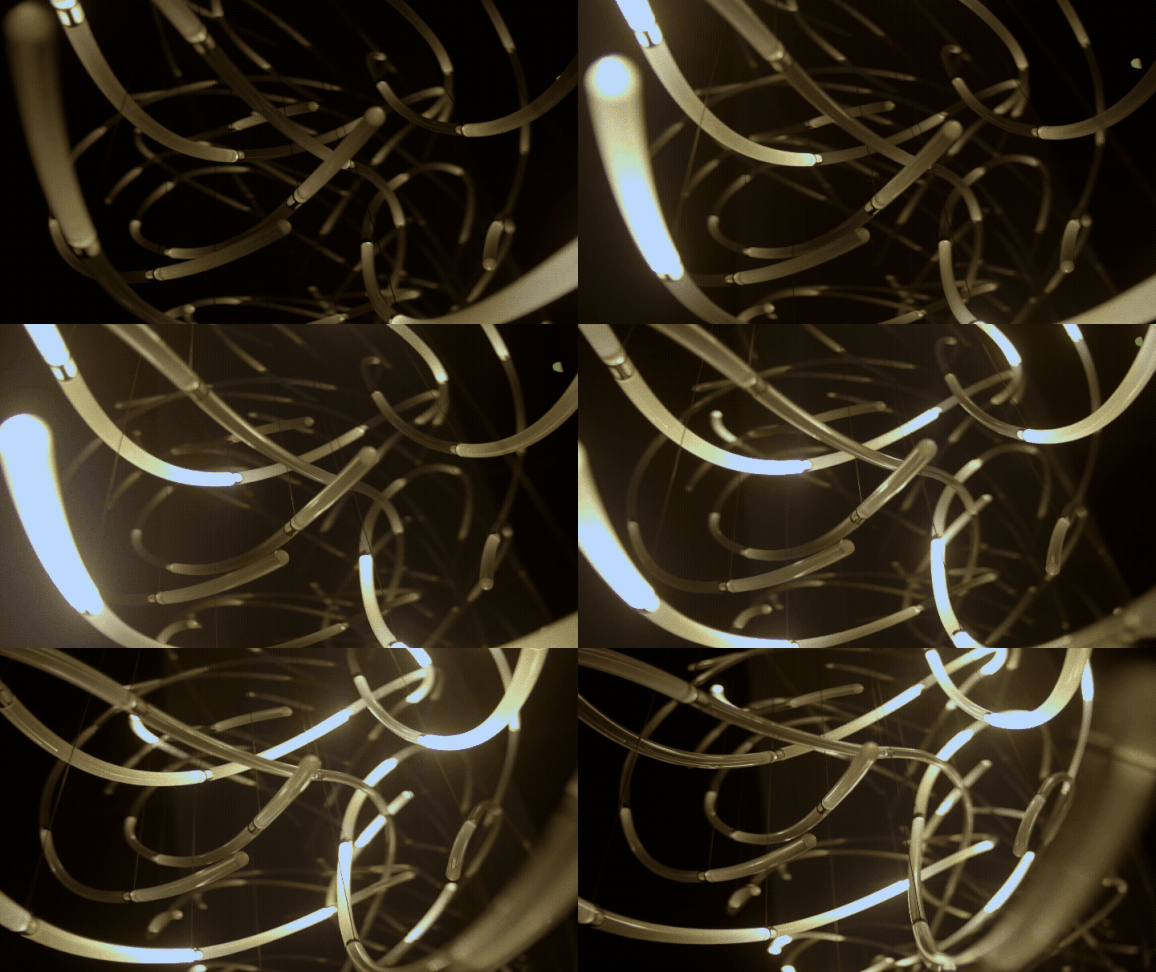
DRIFT's interactive 'Aeolus' (2026) suspends illuminated glass rods that respond to visitors' movements at Carpenters inside Ladbroke Hall, London, through 25 October. The Amsterdam studio also announced a dedicated DRIFT Museum in Amsterdam opening in early 2027.
The Amsterdam studio DRIFT has a long record of making nature behave like choreography, and its new London installation pushes the idea as far as it will go. 'Aeolus', on view at Carpenters inside Ladbroke Hall, fills a room with slender glass rods, each holding a tiny light. The rods respond to visitors' movement, so the room never looks the same twice: stillness one moment, a shifting field of light the next.
The work is named for the Greek keeper of the winds, and the founders, Lonneke Gordijn and Ralph Nauta, describe it as a collaboration between elemental rhythm and built material. Glass and light do the conceptual lifting: the glass can read as solid or spectral depending on the angle, while light itself is immaterial — present one moment, gone the next, much like the wind the piece invokes. The artists' own line on it is that the sculpture 'only fully exists through interaction', a neat summary of an experience that has no fixed state without a body moving through it.
'Aeolus' remains on view in London through 25 October. Its arrival carries a larger announcement with it: DRIFT has confirmed plans for a dedicated museum, an 8,000-square-metre space in Amsterdam's Van Gendt Hallen, scheduled to open in early 2027 — a significant institutional bet on an art practice that has, until now, lived mostly in galleries, festivals and the commercial design world.
For a studio that has built its reputation on translating natural phenomena into controlled spectacle, the museum plan suggests the work is outgrowing the exhibition circuit that made it famous. 'Aeolus' is the latest argument for why.