Exhibition preview·Vienna
Bernhard Leitner Turns Vienna's Secession Into a Living Sound Instrument
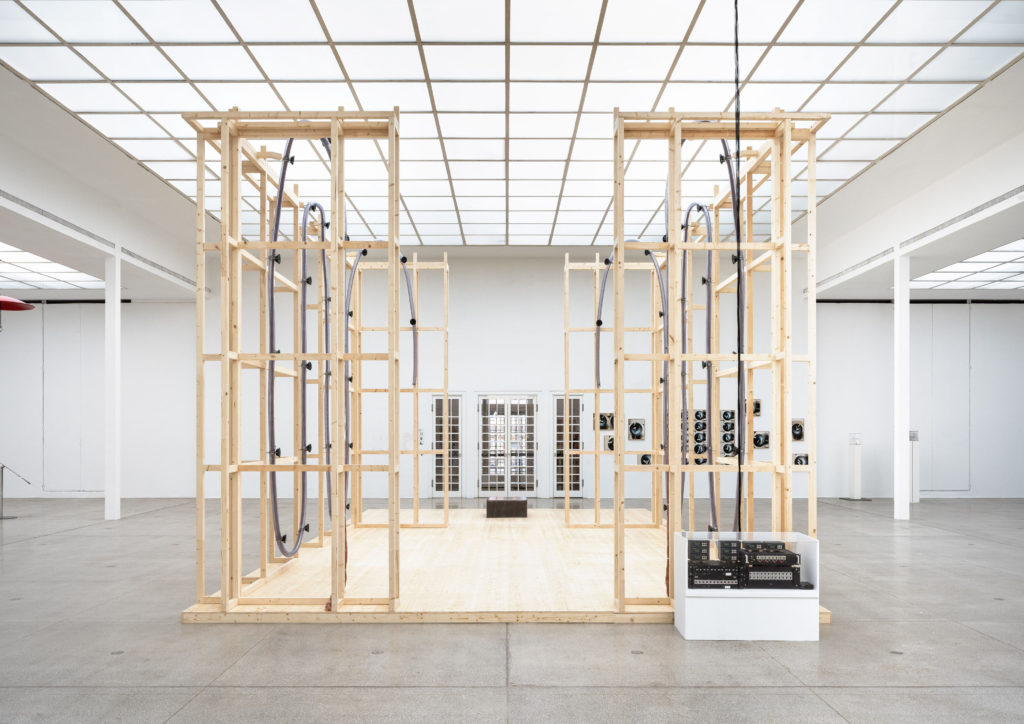
Flash Art reviews Bernhard Leitner's "SOUNDSPACESCULPTURE" at Vienna's Secession, where the pioneer of sound-as-material fills the cube-shaped Hauptraum with a new work, "Water Cube/Wall Waves," answering the city's acoustic traffic-light grid and Cevdet Erek's 2025 intervention.
Vienna's street grid has a voice. Its traffic lights form a networked acoustic-tactile system — the ATA — that emits patterned signals so blind and visually impaired pedestrians can orient themselves and cross safely: a rhythmic code of tocks and ticks woven into the city's soundscape. At the edge of one such street looms the Secession, its gilded Jugendstil cupola crowned with golden foliage. It is here that Bernhard Leitner has staged his latest experiment in sound. The Austrian artist has spent decades treating sound as a physical, living material — a practice formed in the radical, techno-utopian light-and-kinetic art milieu of 1960s Paris. His new exhibition, "SOUNDSPACESCULPTURE," brings that approach to the Secession's main hall, the Hauptraum, itself a perfect cube. Leitner sat with his feet together and knees spread at the opening talk, the reviewer notes, in a posture that seemed deliberately open to listening. The show invites comparison with Cevdet Erek's "Secession Ornamentation" of 2025, which seized the same traffic-light rhythms and turned them into an acoustic ornament on the building's staircase — an ironic gloss on Adolf Loos's 1908 manifesto against ornament. Where Erek applies sound to a surface, Leitner works the other way around, growing sound into the body of the space itself. Central to the installation is a new piece, "Water Cube/Wall Waves," which continues Leitner's long exploration of how sound occupies architecture. For an artist who has long insisted that sound is something to be built with rather than merely heard, the Secession's white cube becomes both instrument and score.