Exhibition preview·New York
Pearls Over Eyes: Amy Liu's Renaissance-Lit Opera Portraits Open at Harper's
Painter Amy Liu's solo show "Pearled Chiaroscuro" is on view at Harper's Apartment on the Upper East Side through December 19. A trained soprano, Liu paints women in jewelled gowns and pearl masks, borrowing Renaissance underpainting and chiaroscuro to explore how fashion conceals identity.
Painter Amy Liu's solo exhibition "Pearled Chiaroscuro" is on view at Harper's Apartment on the Upper East Side in New York through 19 December, presenting a series of oil paintings in which women in jewelled gowns and pearl masks emerge from deep shadow. Liu, who is also a trained soprano, draws on both the Renaissance and a night at the opera.
Like a pearl forming inside a mollusk, Liu builds her pictures in layers of oil pigment over underpaintings, a preparation technique dating to the early Renaissance and first associated with Jan van Eyck, who used a monochrome glaze to fix tonal values before building up the image. She leans into chiaroscuro, the Italian term for "light-dark", the deep contrast and bright highlights familiar from Caravaggio, Leonardo da Vinci and Artemisia Gentileschi, where figures seem to glow from within the dark.
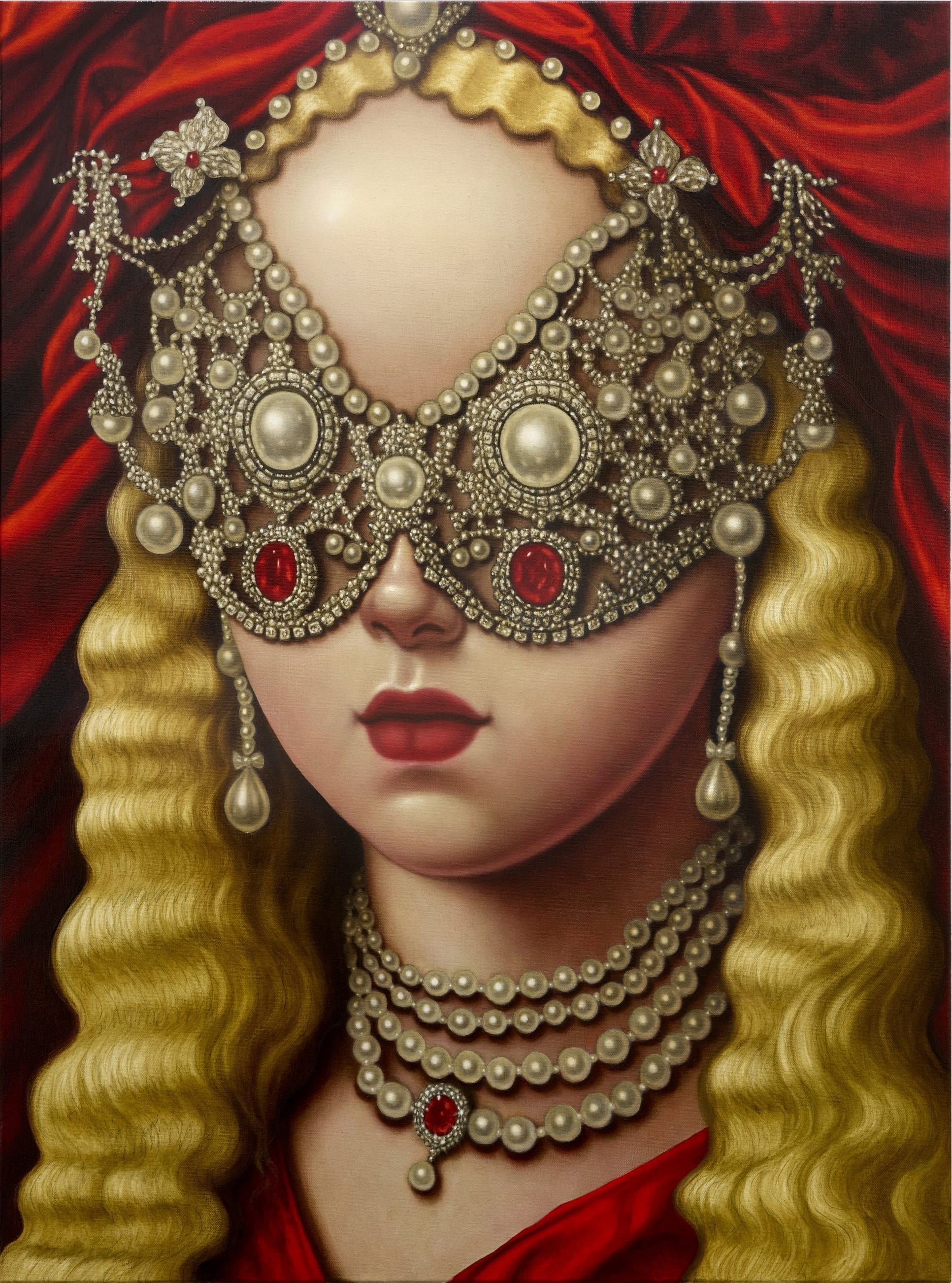
Her subjects are women draped in elaborate jewellery, above all pearls, their faces partly or wholly hidden. In "Il Bacio di Venere", or "The Kiss of Venus", an ornate face covering set with giant pearls and rubies gives its sitter an impractical, almost alien look, while in "Colei che Danza col Vento" ("She Who Dances with the Wind") a cluster of pearls densely covers the figure's eyes. Other works in the show include "Perle al Chiaro di Luna", "Cuore di Giada" and "Signora al Teatro dell'Opera".
By hiding her sitters' identities and viewing them through what they wear, Liu treats high fashion as a channel of status and selfhood, in which garments literally and figuratively mask the person inside them. As the gallery puts it, the figures are abstracted and their identities deliberately concealed, so that they appear to support the ornamentation rather than the other way around.