Exhibition preview·Venice
Warhol's 1977 Kuwait Trip, Reimagined: Raed Yassin Stages a Pop Fiction at the Venice Biennale
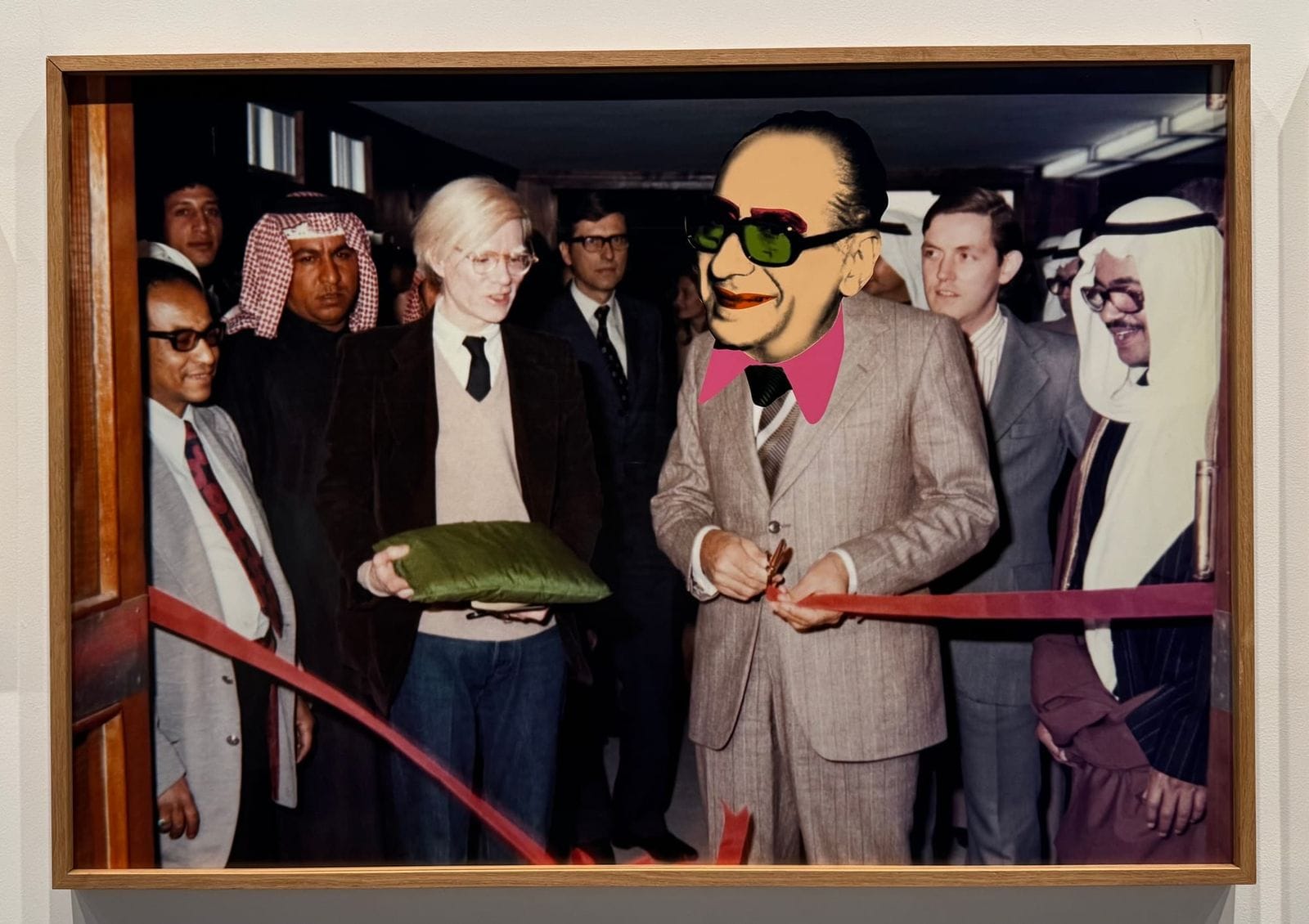
Lebanese artist Raed Yassin's photographic mixed-media series Warhol of Arabia, on show in the 61st Venice Biennale's main exhibition, invents scenes from Andy Warhol's little-documented week in Kuwait in January 1977, when the pop artist skipped Jimmy Carter's inauguration to exhibit in the oil-rich Gulf state.
In January 1977, Andy Warhol turned down an invitation to Jimmy Carter's inauguration and flew to Kuwait instead. Invited by the country's national arts council, he spent a week at tea parties and dinners and held a solo show at the Salat Al Funoon gallery, hanging portraits of Mao Zedong and Marilyn Monroe alongside his flower prints.
At home, Warhol's moment was cooling. Fewer patrons were willing to meet his prices, and he was under pressure to find buyers elsewhere. Kuwait, flush with oil money and newly plugged into Western culture, offered them. Nearly half a century later, that little-documented week is the starting point for a new body of work by Lebanese artist Raed Yassin, now on show in the main exhibition of the 61st Venice Biennale, In Minor Keys.
Yassin's Warhol of Arabia, made between 2016 and 2018, uses photographic mixed media to invent scenes from the trip as though seen by a fly on the wall. In The Party XII, Warhol sits on the floor between a sheikh and a woman in a kaftan; Yassin paints only the artist in colour, with pink hair and yellow glasses, marking him out as the outsider in the room. In The Exhibition XIII, four headscarves in primary colours are stamped across a photograph of Warhol posing with his Campbell's soup can multiples, bending the most American of his images toward the Gulf.
Yassin told Hyperallergic the Gulf of the 1970s felt like a kind of a black hole to outsiders, known for oil and little else, and that he wanted to imagine the social life behind the industry. The result is less a history than a fiction built from a real event, using Pop's own visual language to picture a week when Warhol, the West's most famous artist, went looking for a new audience in Kuwait.