Market dispatch·New York
$11.6M for a Cuban Orisha in the Cane Fields: Wifredo Lam's 1943 'Ogue Orisa' Sets a New Artist Record at Christie's
Wifredo Lam's 1943 canvas Ogue Orisa sold for $11.6 million at Christie's New York on 17 November, a new auction record for the Cuban modernist. Painted in Havana alongside The Jungle and shown at the Pierre Matisse Gallery in 1944, it last sold at auction in 1997 for $1.3 million.
A painting Wifredo Lam made in Havana in 1943, at the height of his powers, became the most expensive work by the artist ever sold at auction on Tuesday night. Ogue Orisa (Eggue Orissa, l'herbe des dieux) reached $11.6 million including fees at Christie's 20th Century Evening Sale in New York, against a $10 million to $15 million estimate. The hammer price was $9.5 million, and the lot carried a third-party guarantee.
The canvas dissolves an Afro-Cuban deity into a tangle of sugarcane and tobacco leaves, painted in the same year as Lam's landmark The Jungle. It was first shown at the Pierre Matisse Gallery in New York in 1944, and it appeared recently in the Museum of Modern Art retrospective Wifredo Lam: When I Don't Sleep, I Dream. The result eclipsed the artist's previous auction record of $9.6 million, set by Omi Obini at Sotheby's in 2020.
The leap in value is striking. The painting last changed hands at auction at Sotheby's New York in November 1997, when it sold for $1.3 million. In the intervening decades Lam has moved from a respected modernist to a central figure of twentieth-century art, with museums and collectors competing for the small number of major Havana-period canvases that reach the market.
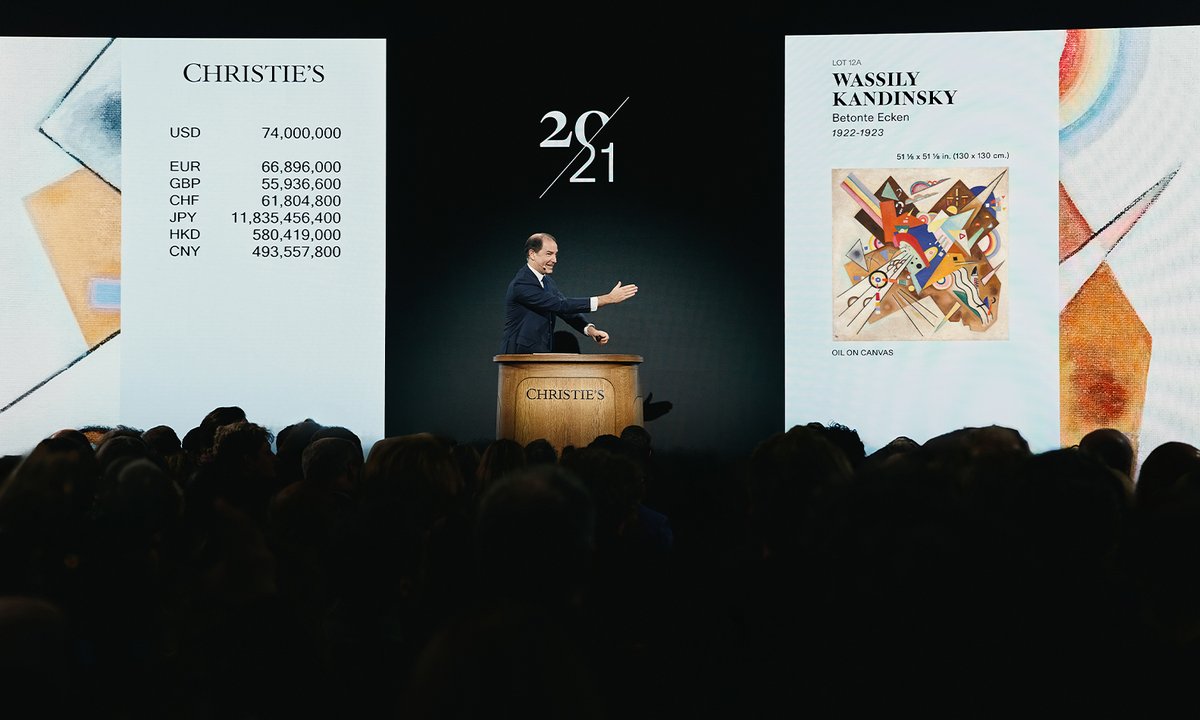
The record was one of six set during Christie's $626.6 million evening sale, a night that also produced a new high for Wassily Kandinsky at $85.8 million. For Lam, whose work fuses Cuban Santeria imagery with European surrealism, the result underlines how firmly Latin American modernism now sits at the top of the market.