Exhibition preview·São Paulo
Vhils and Marcelo Cidade Wrap a São Paulo Building in Silver Emergency Blankets
Artists Vhils and Marcelo Cidade have wrapped a colonial-style building in São Paulo's Pinheiros district in silver emergency blankets, turning its facade into a shifting mirror that reflects the street — and a meditation on buildings that vanish before they are demolished.
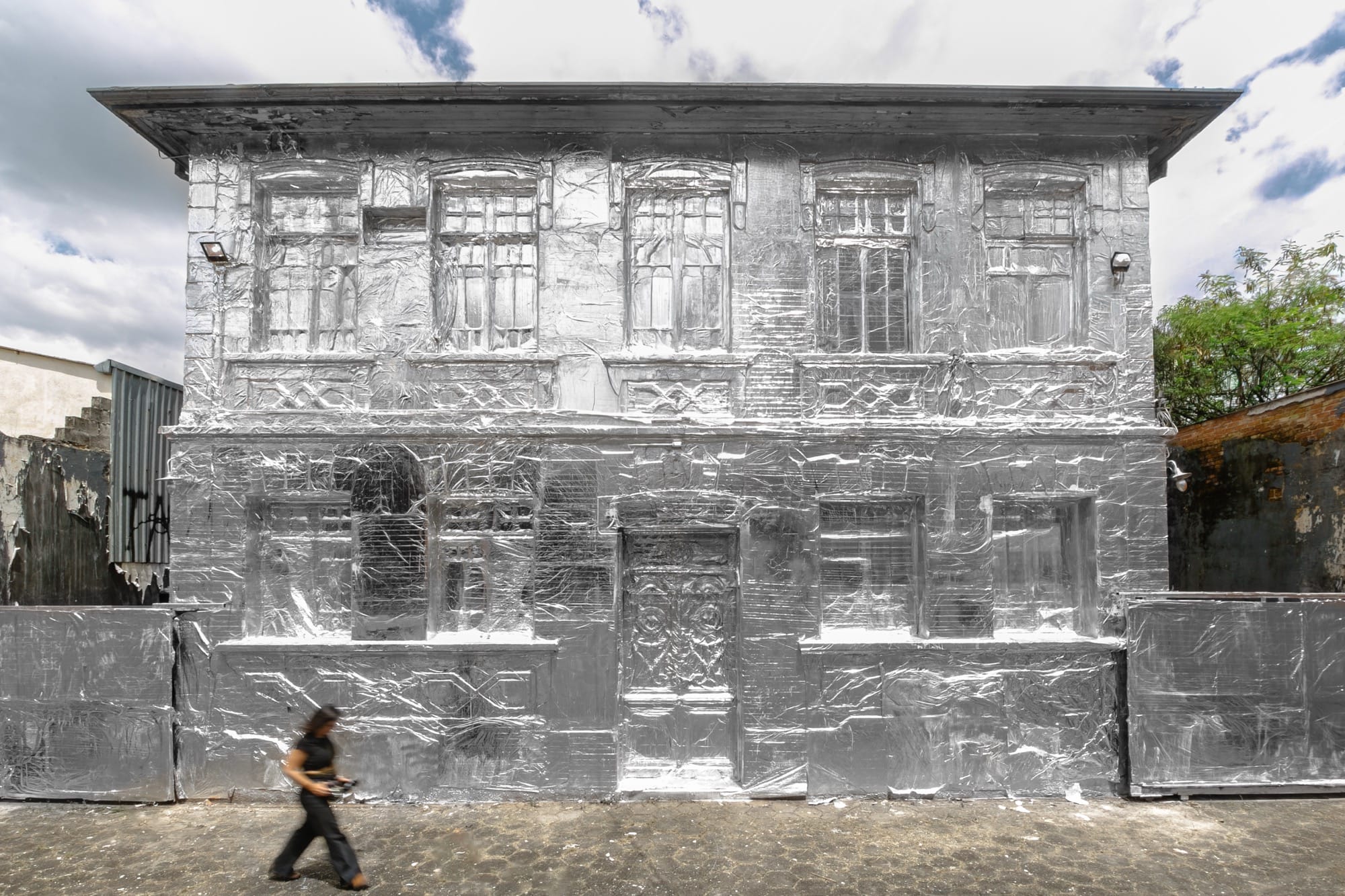
A colonial-style building in São Paulo has disappeared behind a skin of silver. Artists Vhils and Marcelo Cidade have wrapped the facade at Rua Cardeal Arcoverde, 2878, in the Pinheiros district, in thermal emergency blankets bound with cornstarch glue, transforming an ordinary street corner into a shimmering, mirror-like object.
The blankets follow the building's arched windows and ornate patterns, which show through in relief beneath the metallic surface. As the light changes through the day, the facade shifts too, catching the silhouettes of passersby and throwing back fragments of the street. The choice of emergency blankets is deliberate: a material associated with crisis and displacement, here turned into a gleaming architectural skin. The work, titled 2878 after the building's address, is a collaboration between the Portuguese artist Vhils, known for carving portraits into city walls, and the Brazilian artist Cidade.
The project carries echoes of Christo and Jeanne-Claude's Wrapped Reichstag and of the silver surfaces of Andy Warhol's Factory, but its meaning is rooted in São Paulo itself. In the artists' account, a building can keep standing yet slip out of the daily life of its neighbourhood, so that vanishing starts well before any bulldozer arrives.
Photographs of the installation, by Henrique Cabral and Marina Nacamuli, show the silvered facade catching the street's movement like a slow mirror. The piece is temporary, but its image — a familiar building made strange — is likely to linger in the city's visual memory. For now, the address itself has become the work's title and its landmark.