Museum report·Amsterdam
Painted on a kitchen towel: the hidden history on the back of Van Gogh's Daubigny's Garden
The reverse of Van Gogh's Daubigny's Garden reveals the 1890 painting was made on a striped kitchen towel, while its stretcher labels trace a wartime tour across 39 North American cities after the work was stranded abroad in 1939.
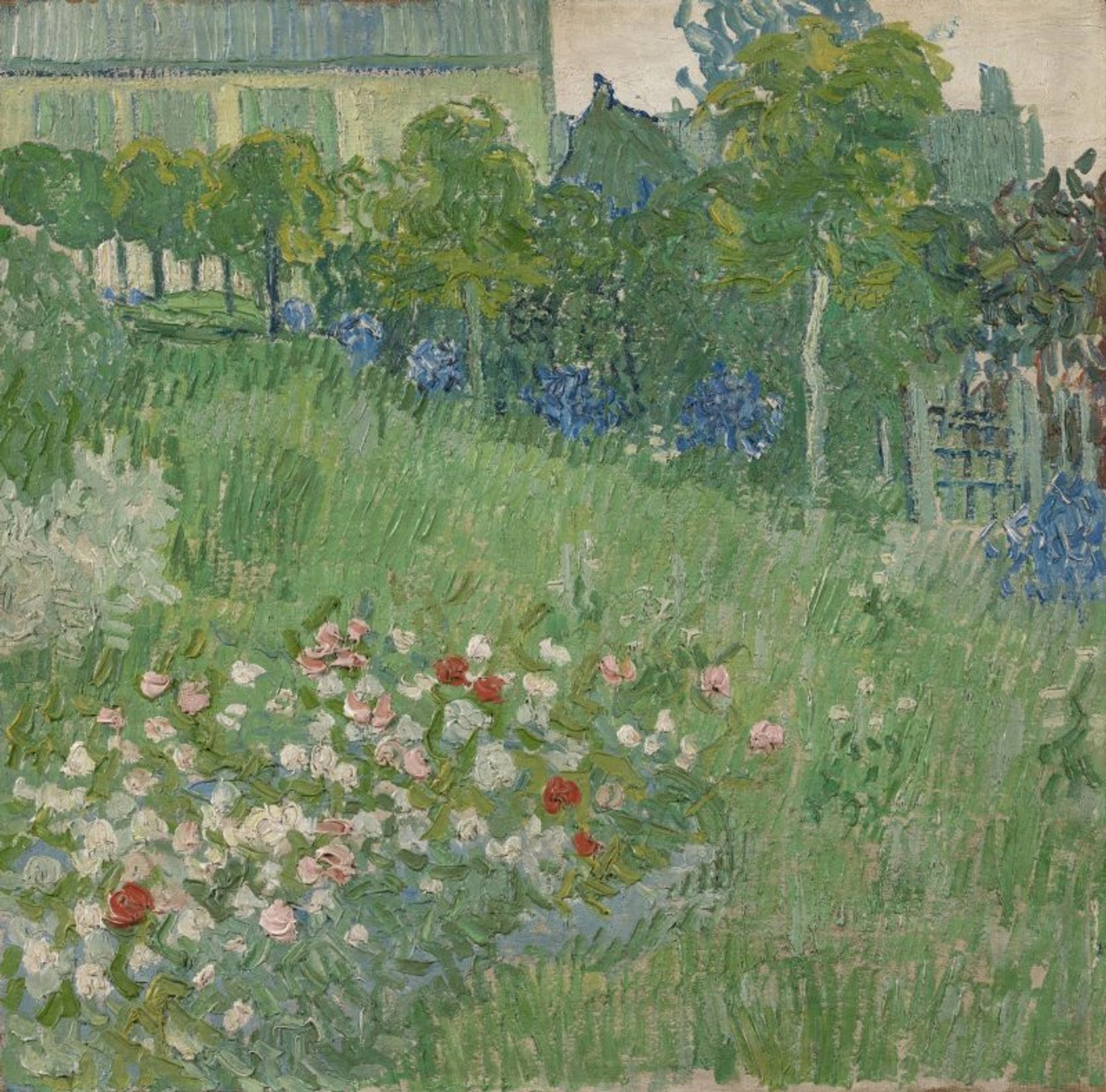
The backs of paintings can hold as much history as their fronts, and few pictures prove it better than Vincent van Gogh's Daubigny's Garden, painted in June 1890 at Auvers-sur-Oise. A photograph of the reverse shows two horizontal red stripes woven into the fabric, because Van Gogh did not paint this work on conventional canvas at all. He used a striped French kitchen towel, known as a torchon, most likely taken from the kitchen of the inn where he was staying, the Auberge Ravoux.
The museum's own account of the picture suggests the artist had probably run out of canvas temporarily and simply reached for whatever was at hand. On 17 June 1890, Vincent wrote to his brother Theo that he had just finished a small study of Daubigny's house and garden, the work on the kitchen towel. That modest experiment gave him the idea of a more ambitious canvas, and the following month, once Theo had sent fresh supplies, he painted two large double-square views of the same garden, now in Hiroshima and in a Swiss collection.
The stretcher is also plastered with small labels recording the exhibitions the painting has visited. Altogether Daubigny's Garden has been lent to 105 shows since 1896, and the labels record 17 of those venues. Among the unlabelled loans were three in Indonesia in 1938-39, when the work travelled with 13 other Van Goghs to Batavia, Surabaya and Bandung, then an unusual destination for such loans.
The final Indonesian show closed in January 1939, and the pictures were sent straight to San Francisco for the Golden Gate International Exposition. When war broke out in Europe that September, it became too risky to return them to the Netherlands, so the 14 paintings were hastily assembled into a travelling exhibition that toured 39 cities across North America between 1939 and 1945, carrying Van Gogh to huge new audiences in difficult years.