Exhibition preview·New York
Shuling Guo's hazy symmetrical paintings turn memory and ritual into sacred space
Shuling Guo's solo show Temple II at Hollis Taggart in New York draws on her Chaoshan upbringing and folk spiritual traditions, rendering devotional imagery in soft-focus oil and coloured pencil. It opens 15 October.
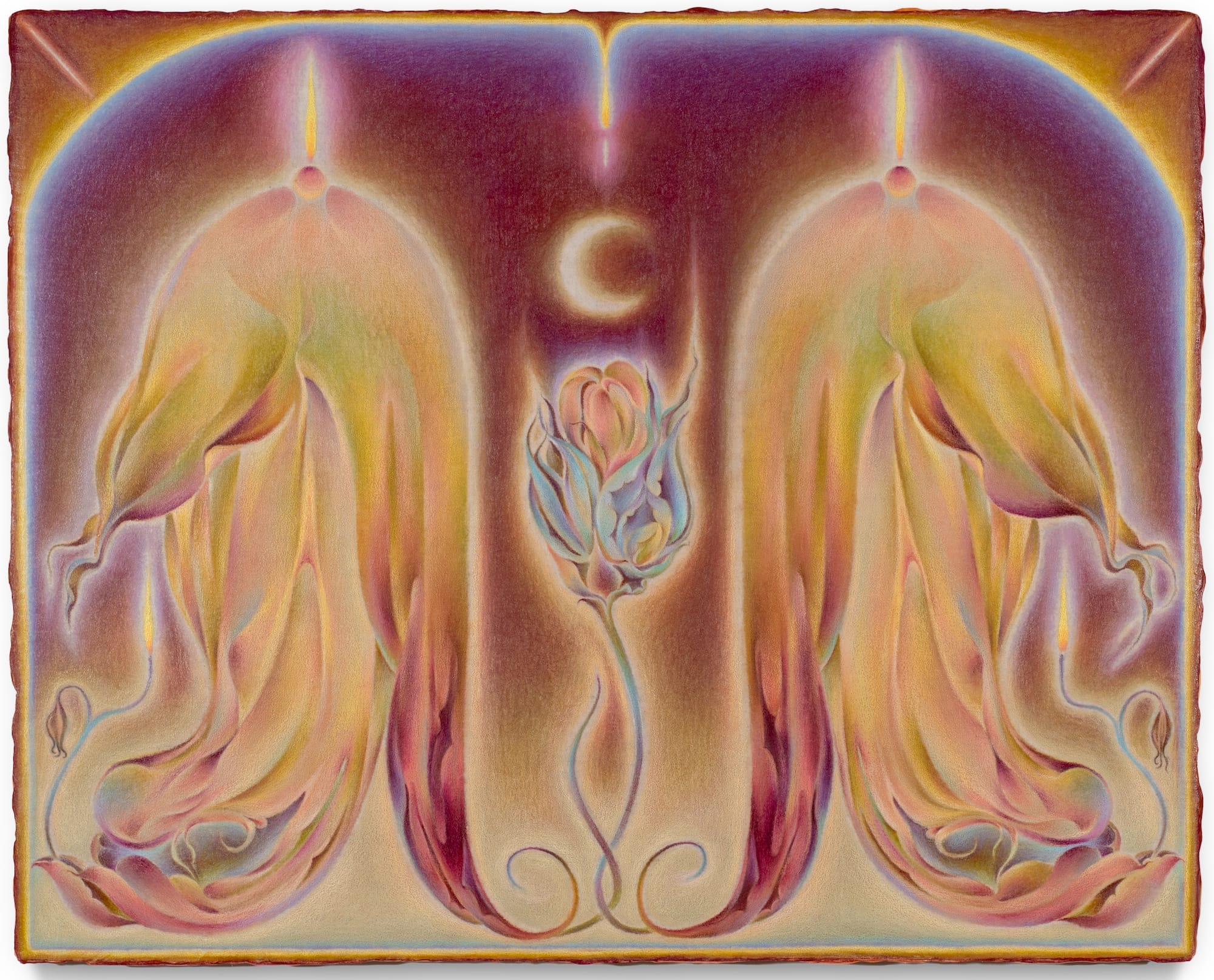
Shuling Guo paints like someone recalling a dream. Her forthcoming solo exhibition Temple II, which opens on 15 October at Hollis Taggart in New York and runs through 5 December, gathers recent works shaped by memory, presence and loss, made in a period that spanned the birth of her daughter and the death of her grandmother. Guo draws on her childhood in Chaoshan, in Guangdong Province, where Daoist and Buddhist practice intermingle with folk custom. She visited her village temple frequently, absorbing its wood carvings, murals and sculpture into her visual memory. In her paintings, blossoming flowers, delicate flames and ribbon-like tendrils glow with a diffused softness, alluding to the transience and fragility of life. The works combine oil paint with coloured pencil to produce forms that feel otherworldly and slightly out of focus. Religious imagery from the early Renaissance informs her compositions, particularly arch-like apertures in which birds perch or flowers droop, while orchids and other blooms carry a quiet sensuality. For Guo, the body itself is a temple, linking physical experience to the psychological and the emotional. The show will also include the artist's first mural, transforming the gallery into an immersive, meditative environment. Taken together, the exhibition traces how devotion and ritual can be explored through the convergence of distinct visual traditions, from sacred symbolism to the harmonies of the natural world. Guo, who divides her time between New York and her family roots in Guangdong, has described her studio process as an act of return, layering colour until forms feel remembered rather than depicted. Temple II consolidates that approach, offering viewers a space shaped by ritual attention rather than spectacle.