Exhibition preview·Global
Moonlit houses, disappearing paths and rooms that open onto forests: Scott Kahn paints landscapes as states of mind
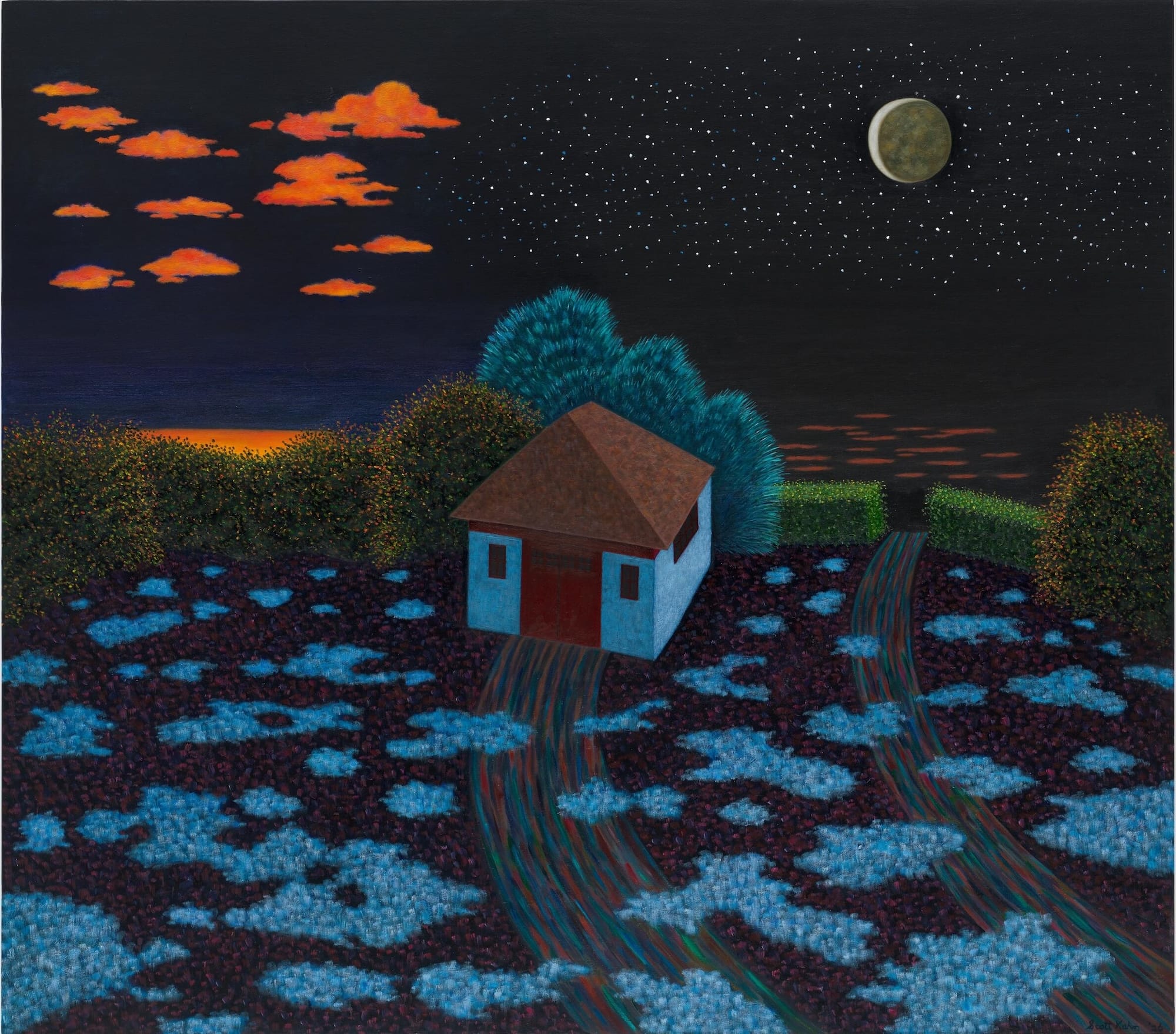
Colossal profiles painter Scott Kahn, whose atmospheric, often surreal landscapes were recently shown as Silent Night at David Zwirner. The self-taught artist builds glowing night scenes in which architecture, trees and shadows blur the line between a real place and a remembered one.
For years, Scott Kahn worked in relative obscurity, living in a cousin's attic with a studio full of paintings that found few buyers. That changed after he struck up a correspondence with the late Canadian painter Matthew Wong, who recognised a shared self-taught background and a shared interest in magical realism. Wong became an advocate for Kahn's work, and when Wong's own career gained momentum in 2018, audiences began to find Kahn's glowing, dreamlike landscapes as well.
Kahn usually paints in oil on linen, arranging houses, trees, windows and balconies so that a familiar scene feels slightly out of reach. Moonlight gives many of the pictures their glow, while long shadows and stretched perspectives make ordinary ground feel unstable. A work from 2005 recalls the rolling hills of American regional painting, while a more recent painting of a stoop lets deep forest darkness press against a sunny domestic threshold.
Several pictures return to the same device: a frame inside the frame. A basement window, a balcony or a doorway opens onto trees that appear both inside and outside the room, so that nature and interior life trade places. One painting draws on a recurring dream of the artist's childhood home, and another treats the vein-like branches and roots of trees as a quiet echo of the body. The effect is less about documenting a location than about holding a mood in place.
The works discussed were recently gathered in Kahn's solo exhibition Silent Night at David Zwirner. Taken together, they suggest why his landscapes resist a single reading: every edge, horizon and vanishing path asks the viewer to decide what is actually there, and what is only half remembered.