Profile·Glashütte
A Working Clock Made Entirely of Trash Ticks in the Birthplace of German Watchmaking
Berlin artist-inventor Niklas Roy built a functioning mechanical clock in Glashütte, Saxony, using only scavenged materials — tape, zip ties, a yardstick, paperclip escapement and a glass-bottle gong — complete with a "random complication" that answers "Now or Never?"
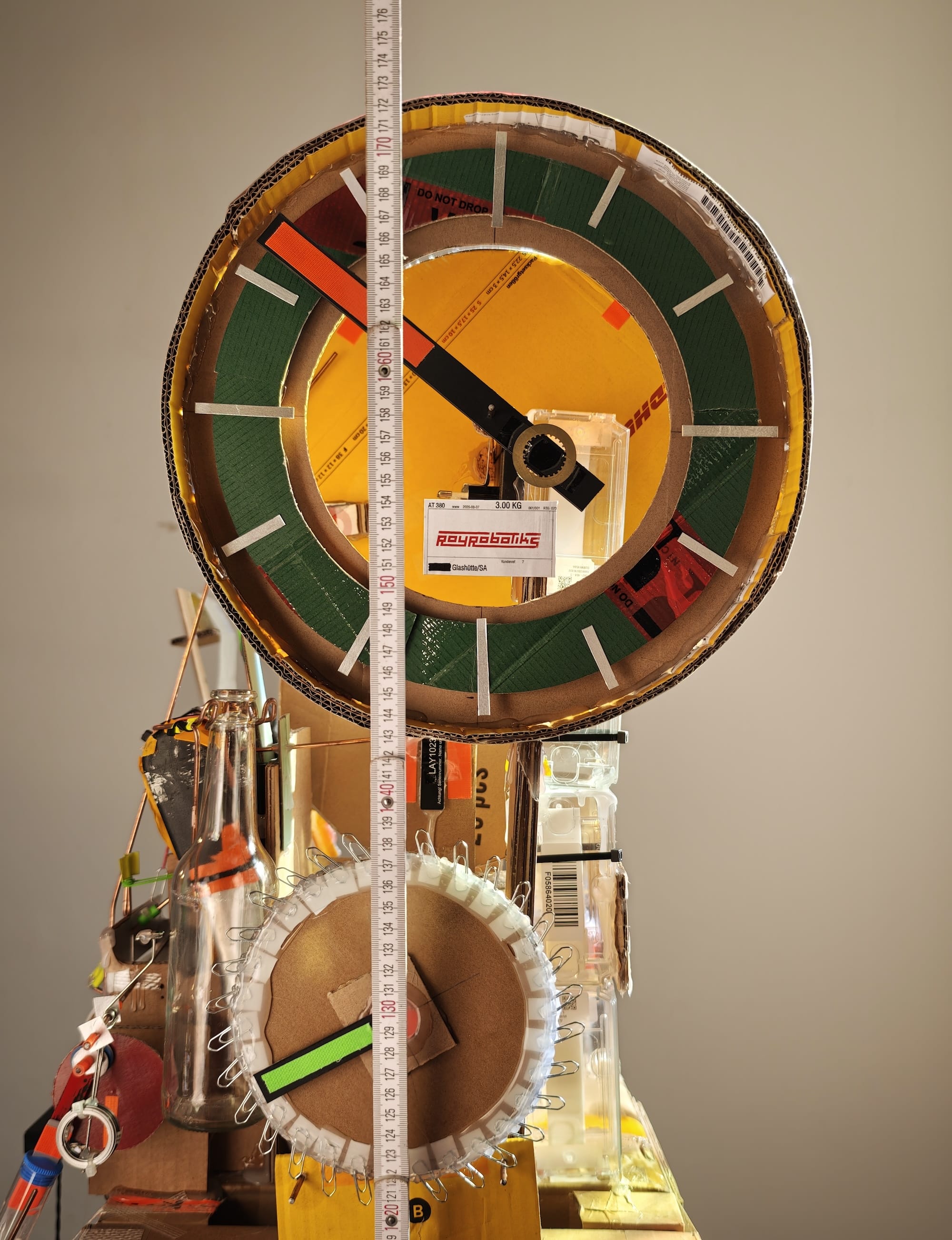
Berlin-based artist and inventor Niklas Roy has built a working mechanical clock almost entirely out of rubbish -- and named it after Glashutte, the Saxon town regarded as the birthplace of German watchmaking, where he undertook a recent residency. The Glashutte Trash Clock was assembled only from materials Roy scavenged locally: packing tape, zip ties, hot glue, cardboard, a wooden yardstick and plastic, pieced together into a functioning timepiece. The escapement -- the mechanism that regulates a clock's movement -- is fashioned from paperclips, and the hour is struck on a gong made from a glass bottle. It runs for roughly half an hour at a time before needing attention. Like all of Roy's contraptions, the clock carries a wry twist: what he calls a "random complication" that, at irregular moments, answers the question "Now or Never?" The joke lands squarely in horological territory, where "complications" are the elaborate extra functions -- moon phases, perpetual calendars -- that distinguish fine watchmaking. Set against the birthplace of German precision timekeeping, the piece reads as both affectionate homage and gentle subversion: horology's obsession with permanence, accuracy and precious materials rendered in the most disposable stuff imaginable. It is Roy's familiar formula -- rigorous mechanical ingenuity deployed in the service of play -- and a reminder that the line between a masterpiece of craft and a pile of junk is thinner than the watch industry might like. In a town where time is measured in centuries of craft, a half-hour clock made of tape and cardboard is both an outsider's prank and a genuine mechanical achievement.