Exhibition preview·London
At the Hayward, Musquiqui Chihying Trades the Supermarket Treadmill for AI Anxiety
A decade-spanning mini-retrospective at London's Hayward Gallery tracks Taiwanese artist Musquiqui Chihying's shift from playful send-ups of daily-grind alienation to uneasy inquiries into automation, data labor, and gaming economies. It closes October 18.
London's Hayward Gallery is in the final days of 'Musquiqui Chihying: A Life of Navigation', a compact retrospective of the Taiwanese artist's work running from August 25 to October 18, 2026. The exhibition draws together roughly a decade of films and photographs that trace how the artist's tone has moved, over ten years, from ironic observation to something closer to anxiety — a generational pivot the show frames as a symptom of the moment.
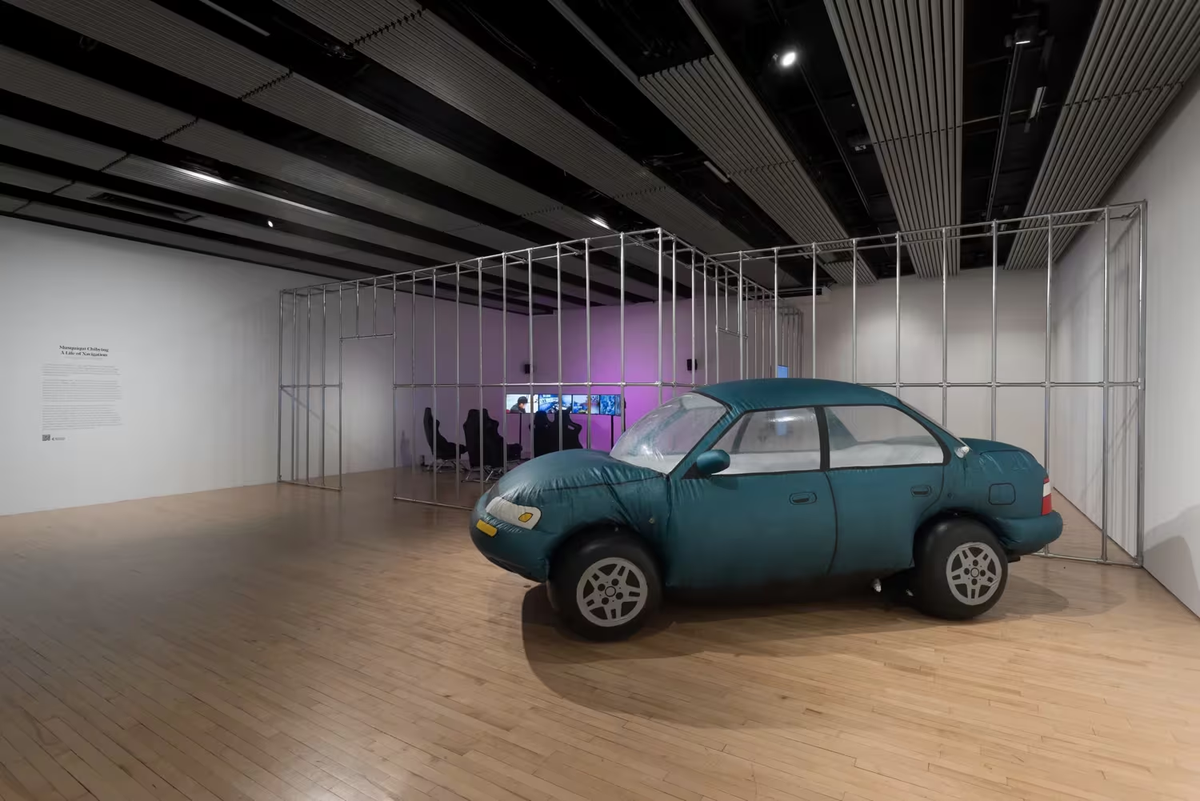
The earliest work on view, 'The Jog' (2014), remains Chihying's calling card: the artist, in little blue shorts, jogs in place on the conveyor belt of a German supermarket checkout while the cashier watches in resigned bemusement. Nearby, 'The Toyota' (2015) assembles six framed photographs of the artist's father laboriously packing away the inflatable plastic car he uses to hold a parking spot. Both pieces take aim at the spiritual emptiness of the daily grind and the squeeze on personal space in cities like Taipei, with the Toyota Corolla standing as a fading emblem of the aspirational prosperity Chihying knew in his youth.
The newer works turn the same forensic curiosity toward automation. 'The Annotation' (2025– ) rigs leather drivers' seats to rumble like engines while AI scholars, journalists, and data workers debate who benefits from self-driving technology, whose labor it exploits, and whose biases shape it. 'The Gamer' (2026) follows young Nigerians who earn a living grinding through first-person shooters for paying clients, mostly in China and Japan — a portrait of underpaid, highly educated workers in former British colonies feeding the AI pipelines of developers elsewhere. Between them, the films extend the unease Chihying once aimed at supermarkets and parking spots into the defining anxieties of the 2020s.


