Market dispatch·Paris
€2 Million Marie-Antoinette Breast Bowl Found in a Crate After 200 Years
The fourth and last known Sèvres breast-shaped bowl made for Marie-Antoinette's dairy at Rambouillet has resurfaced after more than two centuries and will be auctioned at Hôtel Drouot on 26 November, estimated at €1–2 million.
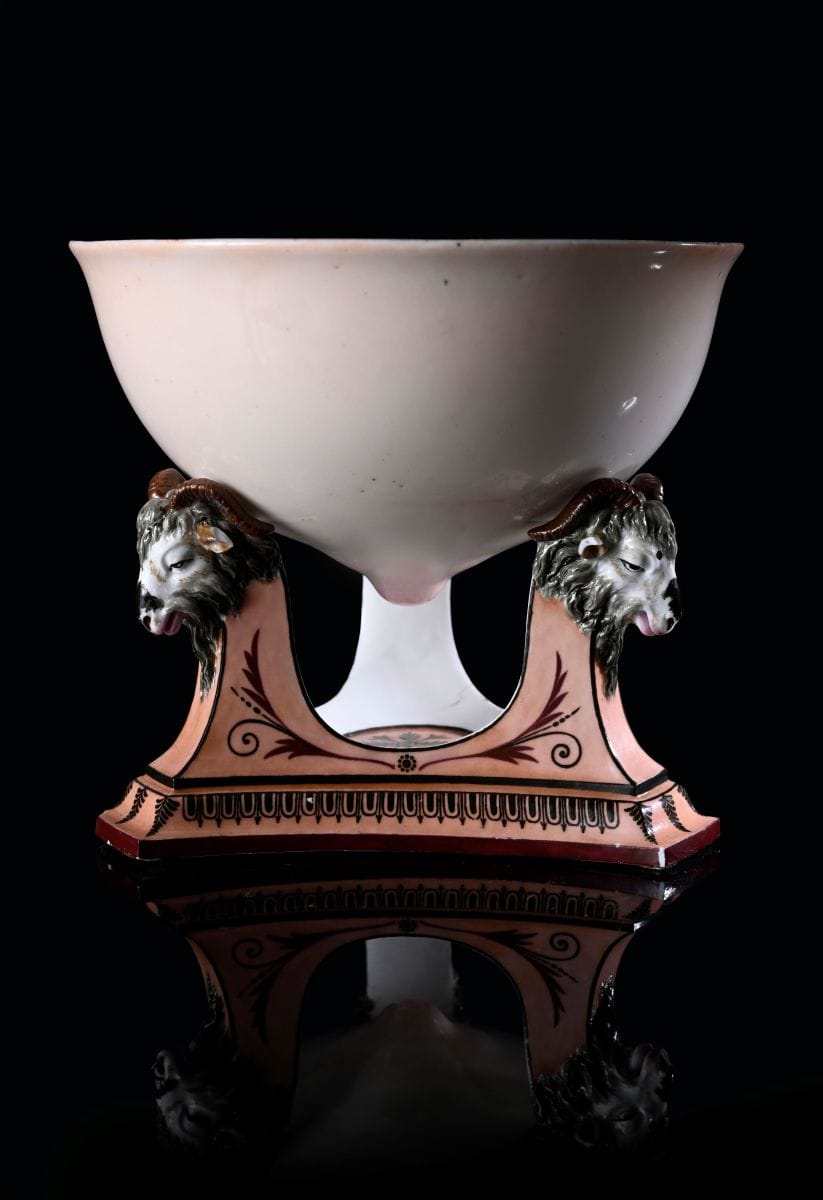
A piece of porcelain that vanished from view for more than two hundred years has turned up by accident in Paris. A breast-shaped bowl from the Sèvres manufactory, commissioned by Louis XVI for Marie-Antoinette's dairy at Rambouillet, was found wrapped in bubble wrap at the bottom of a crate during the inventory of the estate of the Galerie Claude Meyer, a dealership built up over three generations. Coutau-Bégarie & Associés will offer it at Hôtel Drouot on 26 November, with an estimate of €1 million to €2 million.
The bowl, known in the eighteenth century as a jatte-téton, is a hemispherical soft-paste porcelain vessel shaped like a female breast, resting on a triangular hard-paste tripod decorated with sculpted goat heads. The tripod is painted in black and purple with foliate scrolls and egg-and-dart friezes in the Etruscan manner, on an orange-toned ground recorded in the Sèvres archives as fond grès. The interlaced crowned Ls of the manufactory and the date letter KK for 1787 appear beneath the tripod.
Only four such bowls were delivered for the Rambouillet dairy in 1787 and 1788. Three are now in public collections: two at the National Museum of Ceramics in Sèvres and one at the Duca di Martina Museum in Naples. The example coming to auction is the only one of the four still in private hands, which makes its reappearance a notable event for decorative-arts specialists and for the history of the Sèvres manufactory.
Louis XVI bought the Rambouillet estate in 1783 and built an ornamental dairy there to please the queen, with gardens designed with the help of Hubert Robert. The Comte d'Angiviller, director of the king's buildings, ordered an entirely new porcelain service for the setting, taking inspiration from antique vases in the Denon collection and adopting classical forms and Etruscan decoration without any gilding. The bowl's form also recalls the ancient Greek mastos, a breast-shaped drinking cup. A long-standing story that it was moulded from the queen's own breast has no written source before the twentieth century, and Sèvres specialists describe it as a myth.