Exhibition preview·New York
Gretchen Scherer's crowded palace interiors turn art history into a place to wander
Gretchen Scherer's new solo show In Time at Monya Rowe Gallery in New York fills palatial rooms, libraries and cafes with paintings hung salon-style, celebrating handmade craft and the pleasures of looking closely.
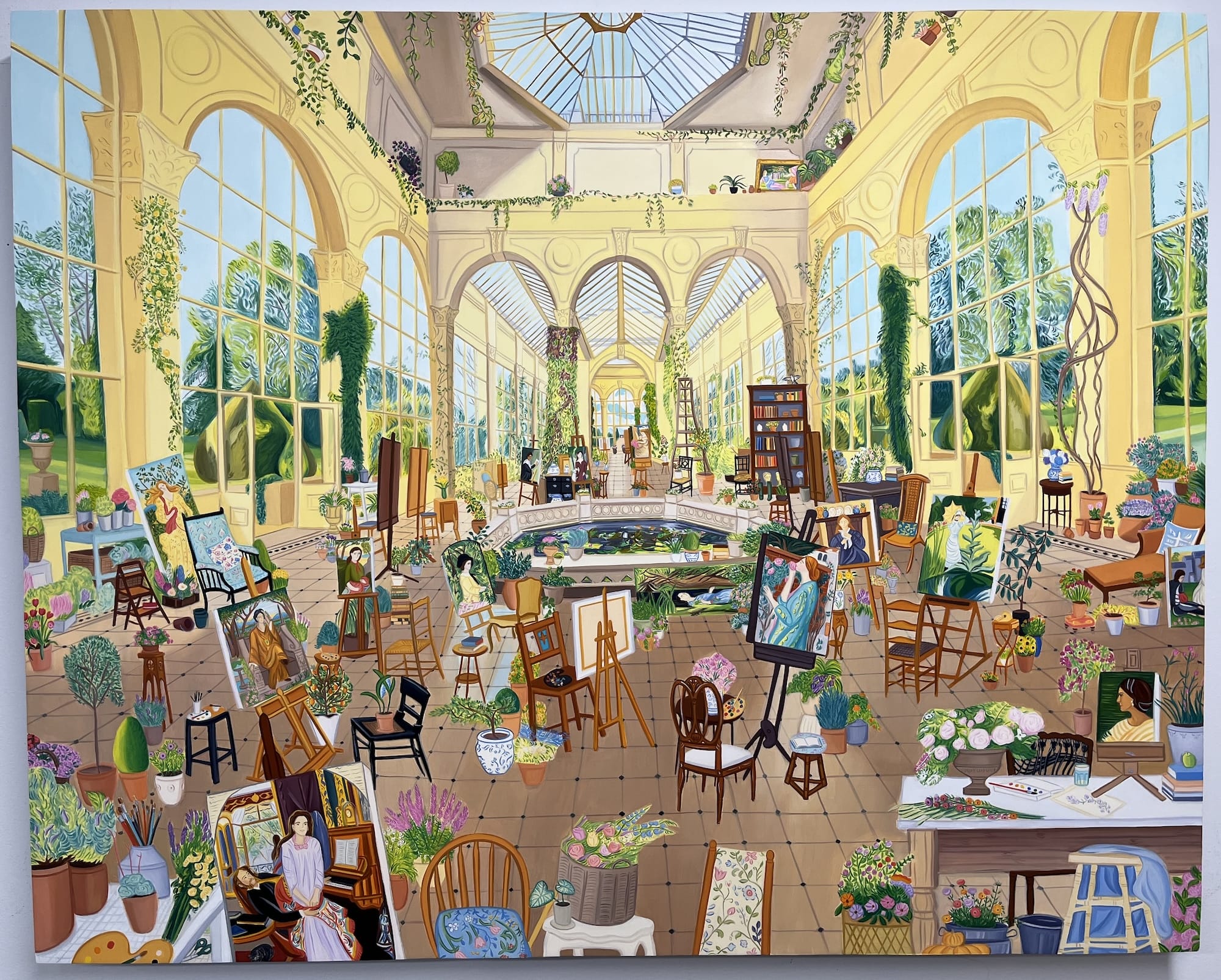
Gretchen Scherer's paintings begin with rooms that already feel full of stories. Her new solo exhibition, In Time, at Monya Rowe Gallery in New York, gathers oil and acrylic panels in which grand interiors — an orangery, a French cafe, a palace painting room, the National Gallery after dark — are crowded with framed pictures hung floor to ceiling. The spaces are part invention and part memory, drawn from real places the artist has visited and then brightened with a playful, almost theatrical warmth.
No people appear in these rooms, except for the figures trapped inside the portraits on the walls. That absence is deliberate. Without a crowd, the eye is free to roam from one small detail to the next: a floral arrangement, a piece of furniture, a familiar masterpiece leaning casually against a wall. In one cafe scene, Klimt's The Kiss and Toulouse-Lautrec's At the Moulin Rouge sit side by side as if they had simply been left there by a previous visitor. The effect is less like visiting a museum than like stepping inside one — a world made entirely of art, where every surface invites a second look.
Scherer works in the same oil tradition as many of the historical paintings she depicts, and that choice matters to the show's argument. At a moment when screens and generated imagery dominate daily looking, her densely worked panels insist on the slow, physical labour of painting. Patterned wallpaper, gilded frames and polished floors are rendered with evident delight in craft, and the rooms themselves — libraries, chapels, drawing rooms, palatial halls — belong to an era that treated decoration as a serious pleasure rather than an afterthought.
In Time opened on October 29 and continues through January 9 in New York. Taken together, the works ask a quiet question about the present: a century from now, what will people have made that deserves the same kind of awe we reserve for these older rooms? Scherer offers no direct answer, only the rooms themselves — luminous, cluttered, and built to be lingered in.