Exhibition preview·New York
Seventeen women who painted with spirits take aim at the patriarchy in New York show
Andrew Edlin Gallery in Tribeca presents Conduits of the Unseen: Women Artists Imagine Other Worlds, gathering 17 women artists who said spirits guided their work and framing their practice as an attack on patriarchal art history.
An exhibition in Tribeca argues that some of the most radical art of the past century was made in collaboration with the dead. Conduits of the Unseen: Women Artists Imagine Other Worlds, at Andrew Edlin Gallery, brings together 17 women artists who attributed their work to communication with spirits, and frames that practice as a challenge to entrenched social hierarchies.
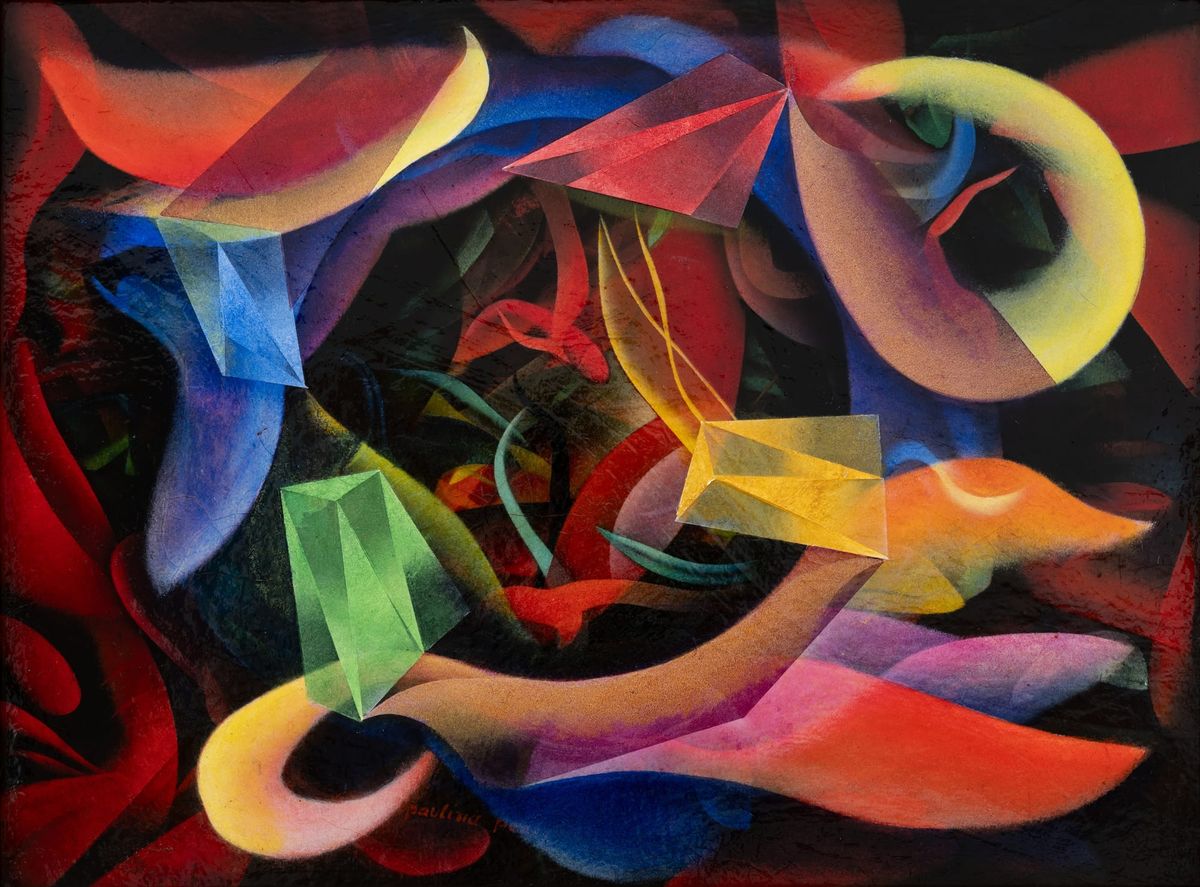
The show's centrepiece is the work of Paulina Peavy, whose jewel-like paintings in oil and acrylic hang against cobalt-blue walls. Peavy said a nonbinary spirit called Lacamo had been communicating with her since the 1930s, and she credited the entity with her vision of humanity evolving toward one-gender perfection. Her vivid, embryonic forms, layered in reds, blues and yellows, read at first glance like stained glass.
Curator Susan Aberth, speaking in a lecture tied to the exhibition, argued that the messages these artists received shared a common purpose: making the world better. The spirits, she said, were remarkably consistent in their prescription, which amounted to abolishing the patriarchy. The exhibition also advances a corrective art-historical claim: Andre Breton took the Surrealist notion of psychic automatism, the suspension of conscious control, directly from women mediums, then stripped out its spiritual content and recast it as psychology.
The show arrives at a moment of growing appetite for occult-themed exhibitions, but its curatorial stance reaches beyond atmosphere. By insisting that spirit communication was a legitimate artistic method, one whose practitioners were largely women and largely written out of the standard modernist narrative, the exhibition asks what else the history of art may have missed. Conduits of the Unseen is on view at Andrew Edlin Gallery in Tribeca, New York.