Exhibition preview·Luxembourg
Christine Sun Kim builds a monument to Deaf culture inside Mudam Luxembourg's chapel-like pavilion
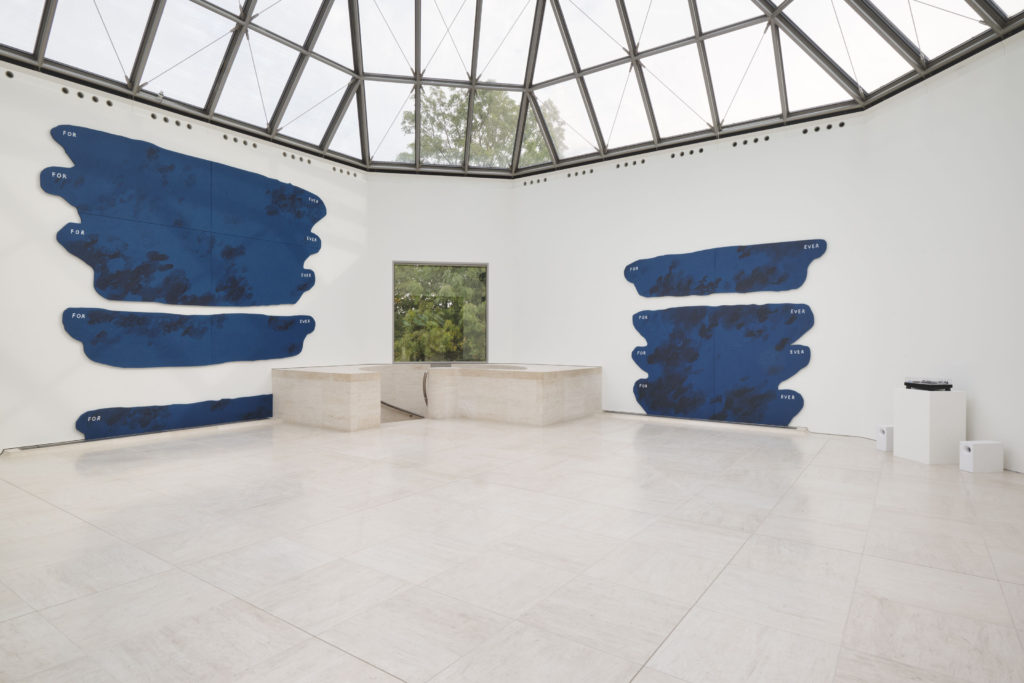
"FOR EVER," Christine Sun Kim's site-specific commission at Mudam Luxembourg's Leir Pavilion (Sept 25, 2026–Jan 10, 2027), combines sculptural canvases with a Matt Karmil soundscape as a monument to the longevity and resilience of Deaf culture.
Deaf artist Christine Sun Kim has taken over the chapel-like pavilion at Mudam Luxembourg with "FOR EVER," a major site-specific commission that runs from September 25, 2026 to January 10, 2027. Conceived for the Henry J. and Erna D. Leir Pavilion, the project is presented as a monument to the endurance of Deaf culture — an assertion that deaf people have always existed and will continue to do so with pride.
The exhibition pairs sculptural canvases with a soundscape developed in collaboration with musician Matt Karmil. Kim's practice has long treated sound as a social and political force, pulling apart how oral languages function as currency in everyday life. Musical notation, written language, infographics, American Sign Language, the movement of the body and a dry, strategic humour recur across her drawings, performances, videos and large-scale murals, all circling her relationship to spoken and signed language and the environments built around them.
The pavilion's architecture does much of the conceptual work. Its chapel-like form invites the language of monuments and permanence, and Kim answers by materialising the word "forever" again and again — a repeated insistence that Deaf history is not a footnote to be accommodated but a continuous presence. The curators are Leon Kruijswijk, assisted by Hollie Douglas.
Kim, born in 1980 in Orange County, California and now based in Berlin, has shown at the Whitney Museum, Tate Modern, the Mori Art Museum and the Secession in Vienna, and took part in the Whitney Biennial, the Berlin Biennale and the Gwangju Biennale. "FOR EVER" arrives as her largest statement yet on the institutional stage, placing Deaf culture at the centre of a national museum rather than at its margins.


