Exhibition preview·Paris
Rebuilt from Ghana's ruins, Mahama's Paris show turns salvage into a shared future
Ibrahim Mahama's first major Paris exhibition, The Harvest Season at Fondation Cartier, rebuilds a derelict Ghanaian glass factory and assembles Asante stools into a chamber for public discussion, alongside nine invited artists and collectives.
Ghanaian artist Ibrahim Mahama has taken over the Fondation Cartier in Paris with The Harvest Season, which opened on 22 October and runs until 28 February 2027. Presented as his first major exhibition in the French capital, it fills the institution with large-scale installations built from salvaged industrial material, shown alongside contributions from nine invited artists and collectives.
At its centre stands Parliament of Ghosts, an assembly of traditional Asante stools arranged as a circular chamber that visitors can enter and sit in. Many of the stools were carved in southern Ghana in the nineteenth and twentieth centuries, and some arrived damaged and had to be repaired before travelling to Paris. Rather than treating them as museum relics, the work turns them into seats for conversation, asking whose voices are remembered in public life and whose are left out.
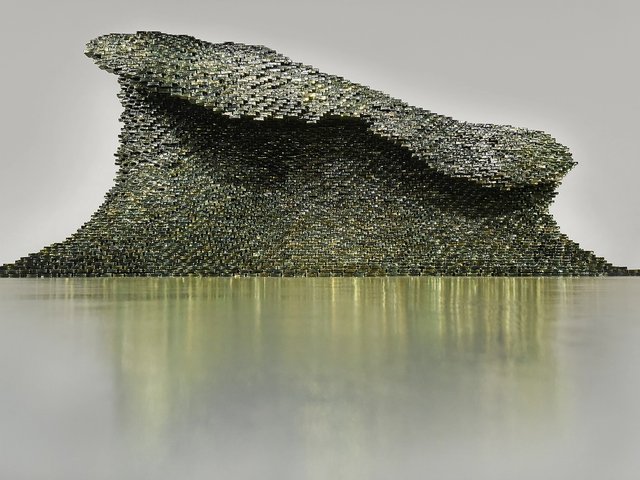
A second anchor revisits the Aboso Glass Factory in western Ghana, founded in 1966 and once the largest glass plant in sub-Saharan Africa before it was decommissioned. Using funds from the Cartier commission, Mahama acquired material from the defunct site and partly rebuilt it in Paris, including a red-brick pool filled with emerald-green bottles produced during Ghana's post-independence years, topped with terracotta pots that nod to regional craft traditions.
The wider presentation shares the space with contributors including photographer James Barnor, Dorothy Akpene Amenuke, Gideon Appah and the Congolese collective CATPC. Together, the installations revisit Ghana's colonial and post-independence histories through labour, industry and unfinished national projects, framing salvage and repair as a way of imagining a collective future rather than simply mourning what was lost.