Market dispatch·London
Damien Hirst Redesigns Dom Pérignon's Label for Two Vintage Releases
Damien Hirst has created a limited-edition label design for Dom Pérignon, breaking the house's shield into kaleidoscopic patterns. Two palettes — deep blue for Vintage 2018 and warm pink for Rosé Vintage 2010 — frame the end-of-year release as Tate Britain prepares its 'The 90s' exhibition.
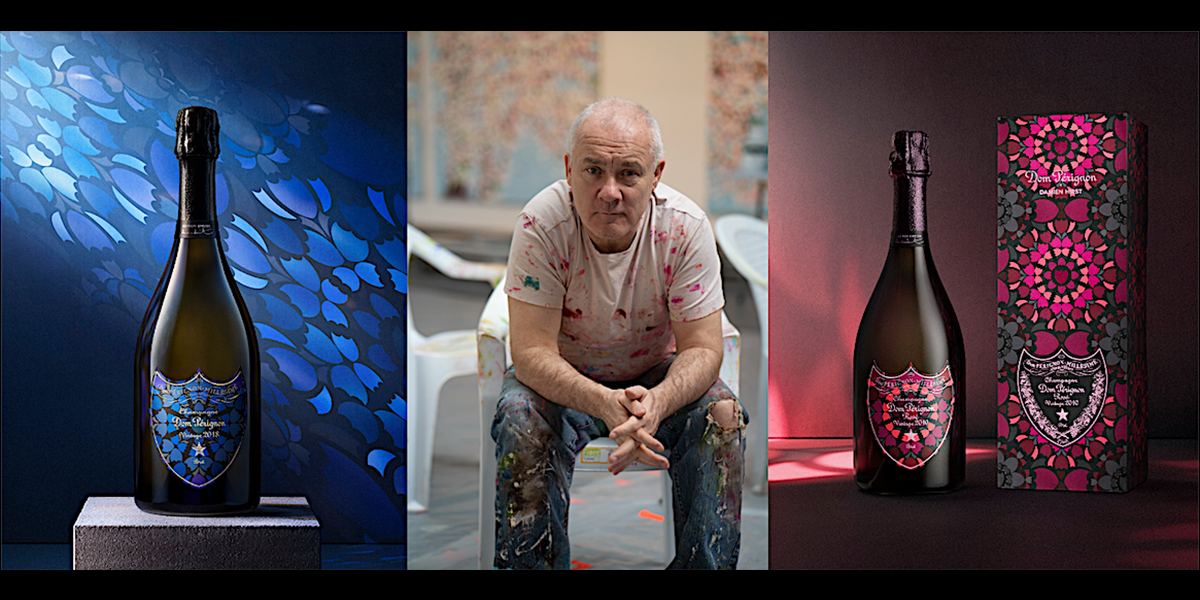
Dom Pérignon has enlisted Damien Hirst to design a limited-edition champagne label, pairing one of Britain's most commercially successful and debated artists with the champagne house's end-of-year release. The collaboration lands as Tate Britain prepares to open The 90s: Art and Fashion — a fitting moment, since Hirst did more than almost any other British artist to define that decade. The 2026 limited-edition design takes Dom Pérignon's shield emblem and subjects it to Hirst's signature kaleidoscopic treatment: the emblem is broken apart and multiplied across the label in shifting, layered configurations, repeating with slight vibrations so the pattern seems to keep moving. The shield never disappears inside the pattern; instead it functions as a visual metaphor for the tension the house has always sought between tradition and reinvention. The approach maps closely onto Hirst's long-standing preoccupation with repetition and transformation — the Spot, Spin and Kaleidoscope paintings all multiply and refract across the surface — and, by his own account, onto the Maison philosophy he described as a living material that grows through experimentation rather than standing still. Two colour palettes are tied to the two vintages. A deep blue, evoking infinity and a spiritual quality, wraps the Vintage 2018; a softer, warmer pink built around Pinot Noir characterises the Rosé Vintage 2010. The vintages themselves differ sharply: the 2018 benefited from near-ideal growing conditions and was pushed by chef de cave Vincent Chaperon toward minerality, sweetness, fruit and salinity, while the Rosé 2010 is a more interior, shadowed wine with unusual density and assertiveness, continuing the house's pursuit of intensity in its rosés. Born in Bristol in 1965, Hirst came to attention curating the 1988 Goldsmiths show Freeze, which effectively launched the Young British Artists, and has since mounted more than ninety solo exhibitions, including Tate Modern in 2012 and the Pinault Collection in Venice in 2017. The pairing is timed to ride the current appetite — among both nostalgic Millennials and pre-smartphone-curious Gen Z — for a reassessment of the nineties.