Museum report·Künzelsau
An 11-Metre Kiefer Gets Its Own Chipperfield Pavilion After 18 Years in Storage
Reinhold Würth bought Anselm Kiefer's 11.2m-tall Black Flakes (2007) in 2008 and stored it ever since; now the artist and David Chipperfield have built it a purpose-built 140 sq. m pavilion in Künzelsau, opened 13 October.
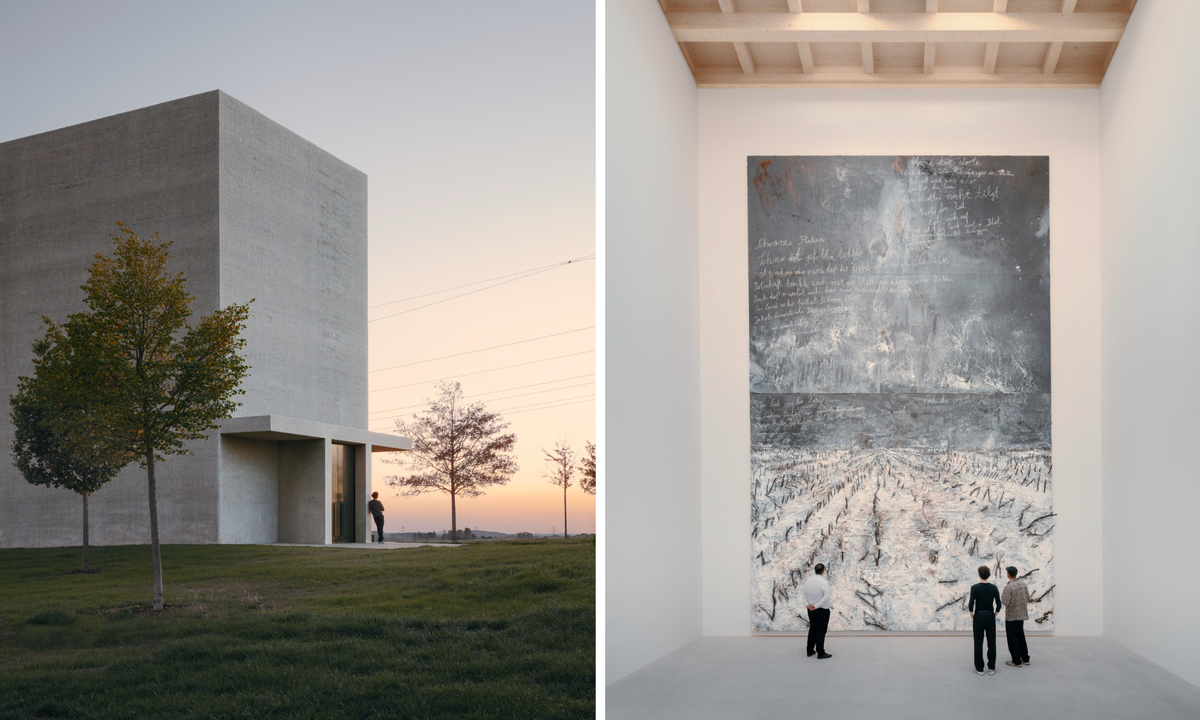
A monumental Anselm Kiefer painting that spent almost two decades in storage is finally on public view following the opening of a purpose-built pavilion in Germany. The industrialist and collector Reinhold Würth bought Schwarze Flocken (Black Flakes, 2007) — 11.2 metres high and 7.1 metres wide — directly from the artist's studio in 2008. It was simply too large for any of the Würth Collection's exhibition spaces, so last year the Würth Group commissioned the British architect David Chipperfield, working closely with Kiefer, to design a pavilion exclusively for it. It opened on 13 October in the sculpture garden beside Museum Würth 2 in Künzelsau, northeast of Stuttgart.
Made with oil, emulsion, shellac, earth and branches on canvas, Black Flakes takes its title from a poem by Paul Celan, the Romanian Jewish poet whose parents died in Nazi camps during the Holocaust. Kiefer has long drawn on Celan's poetry while exploring German history and memory.
Kiefer himself proposed the freestanding pavilion and specified the room's proportions, the doorway's size and position and the wall colours. Chipperfield's Berlin office translated those requirements into a 140 sq. m concrete building, where a sheltered portico marks the transition from the surrounding landscape and roof lights admit natural light.
Maria Würth, Reinhold's granddaughter and the group's executive vice-president for arts and culture, said the pavilion slows the act of looking and focuses attention entirely on the artwork. In the presence of Celan, she noted, three masters meet as equals: Chipperfield, Kiefer and Celan. The opening coincides with the reopening of Kunsthalle Würth in nearby Schwäbisch Hall after a three-year renovation, whose 25th-anniversary exhibition Anselm Kiefer—All That Is the Case (until 3 October 2027) brings together more than 70 works from the Würth Collection and 21 loans from the artist's studio.