Exhibition preview·New York
Tang Shuo Paints Fictional Selves Into an Imagined Family Archive in New York Solo Debut
Chinese painter Tang Shuo brings 'Borrowed History', his first solo exhibition in New York, to Plato Gallery. Working from photographs of himself, he renders his own likeness in imagined postures of his ancestors, blending rural childhood memories with magical realism.
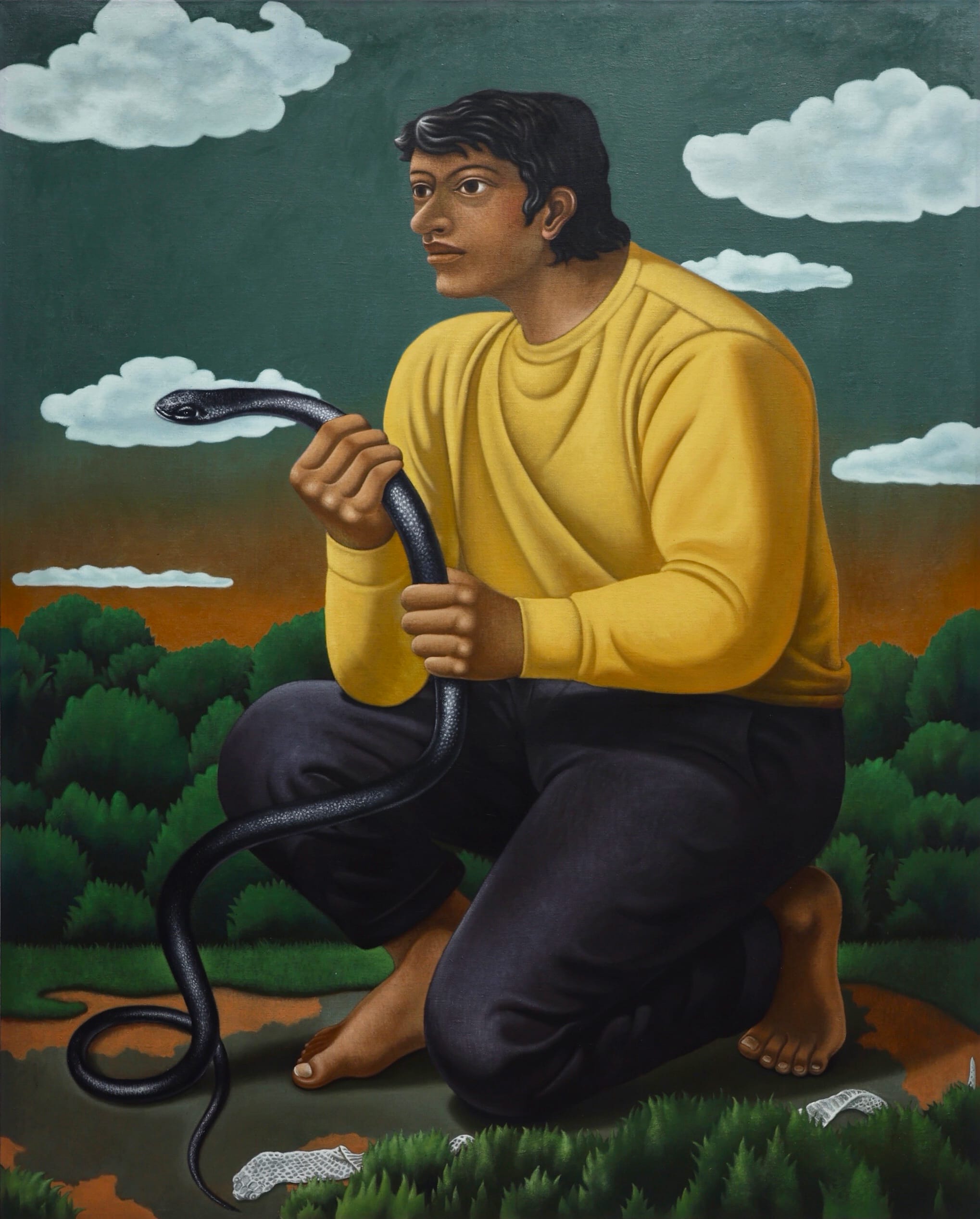
Painter Tang Shuo is presenting 'Borrowed History', described as his first solo exhibition in New York, at Plato Gallery. The body of work extends the artist's long-running interest in ancestry and his ties to the land where he grew up, in Dashishan Village in southern China. Tang stages himself as a stand-in for relatives he never knew. Painting from photographs of his own face and body, he imagines positions his kin might once have occupied: 'The Migrant' carries a small sack slung over his back, while 'The Settler' hoists a tree trunk among scattered tools and bones. The two canvases are rendered in oil on linen, at 100 by 80 centimetres and 150 by 120 centimetres respectively, a scale that holds the viewer at close range. In 'Make Peace with Snakes' (2026, oil on linen), he confronts a childhood fear of snakes, gripping a sleek black serpent above its discarded shed skin. The artist grew up with several generations of the Tang family in a small farming community, tending crops and sheep. Those years feed directly into the imagery: lush forests and candy-coloured clouds fold past and present into one another, and Tang has pointed to Gabriel García Márquez's 'One Hundred Years of Solitude' as an influence on the work's atmosphere of magical realism. Rather than documenting a verifiable genealogy, the paintings propose that terrain itself carries memory forward. Nature and landscape become the thread connecting the artist to those who came before, turning the exhibition into a tender, invented archive of belonging.