Exhibition preview·London
Salman Toor paints the thresholds of queer migrant life at the Courtauld
ArtReview's feature on Salman Toor's first European institutional show at London's Courtauld Gallery traces how his paintings turn borders, airport checkpoints and queer kinship into thresholds, from his 2019 inspection-table scenes to the drooping 'fag puddle' assemblages and his monumental studio painting.
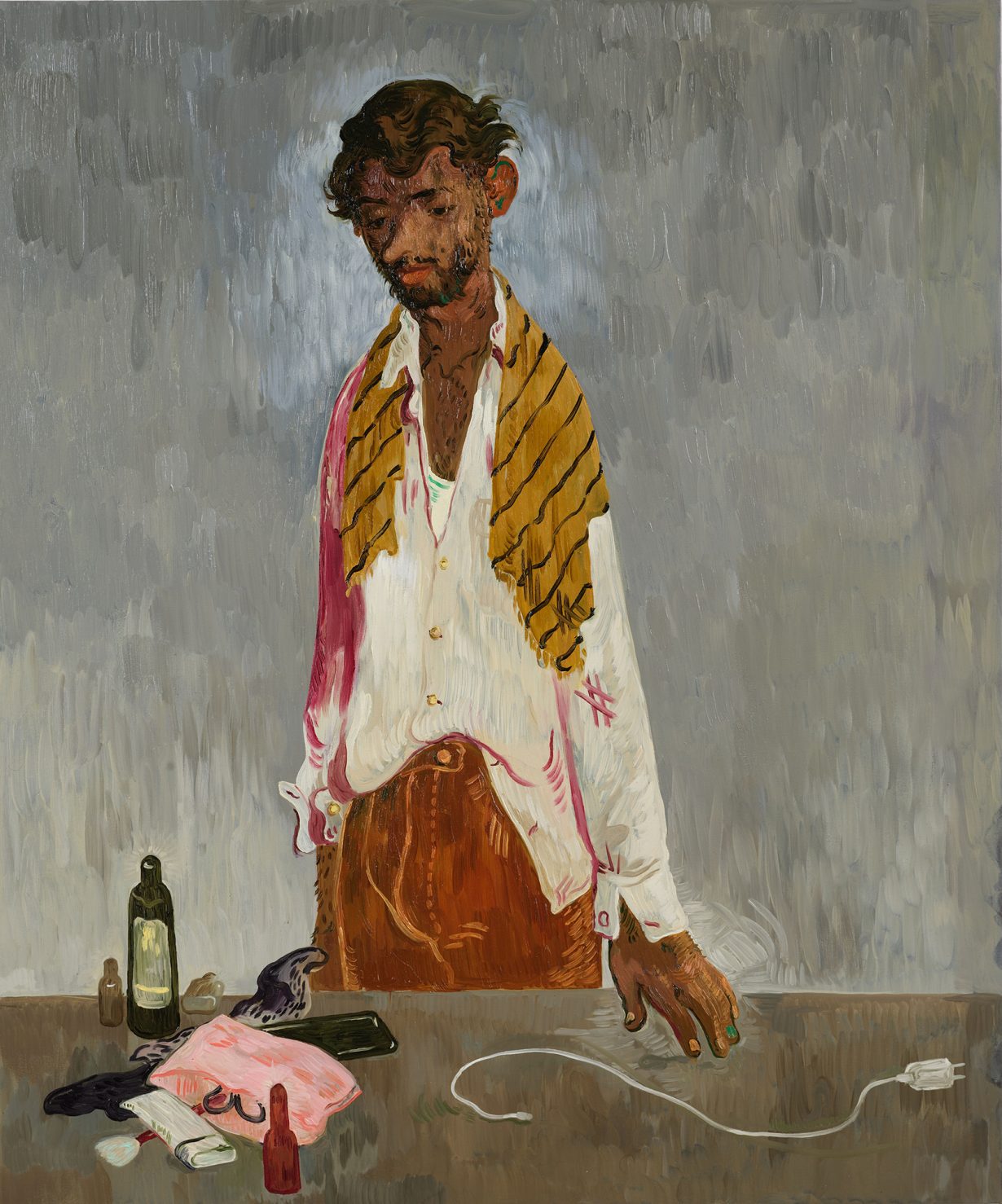
Pakistani-American painter Salman Toor has his first institutional exhibition in Europe at the Courtauld Gallery in London, where nearly forty paintings and drawings made since 2019 are on view through 10 January 2027. Curated by Elena Crippa, the show, titled Someone Like You, follows Toor's interest in borders, checkpoints and the negotiations of queer migrant life. Toor moved from Lahore to the United States in 2002, and his work draws on personal and shared encounters with border controls and racial profiling in the years after 9/11. A recurring motif is the threshold: a bar counter, a glowing screen, an airport inspection table. In Man with Face Creams and Phone Plug (2019), a traveller stares down at his belongings scattered across a counter. The composition adopts the viewpoint of the inspecting officer, so the viewer looks at the scene from the position of authority rather than alongside the traveller. Other airport works place immigrant bodies at the checkpoint, turning an administrative moment into the emotional centre of the picture. The exhibition also traces a device Toor calls the fag puddle: a drooping heap of assorted objects, fabrics and body parts that first appeared in his 2019 series Parts and Things. A later drawing in the series, Fag Puddle in Vitrine (2021), entered the Courtauld collection in 2024 and prompted the current show, which includes a new version, Fag Puddle with Carriers (2026). Toor links the form to the oozing purple slime villain from the cartoons he watched as a child, and treats these piles as props for shifting behaviour between social settings, a visual equivalent of code-switching. The largest painting on view, The Studio (2026), reworks the arrangement of Velazquez's Las Meninas at monumental scale, replacing the court with a green-screen studio, a shoeless wanderer figure and a pair of blue candles. A quieter highlight is The Women (2021), set in an olive-green bedroom where three women lounge on a bed while an adolescent hovers by a dressing table, caught between curiosity and fear. Together, the works frame belonging as something improvised, in rooms and queues where acceptance is never guaranteed.