Exhibition preview·Johannesburg
Johannesburg Show 'Reverse Futures' Imagines a Decolonial Future Built on the Past
The Joburg Contemporary Art Foundation's group exhibition Reverse Futures asks artists to imagine a future shaped by the Global South, contrasting an extractive, militaristic vision of tomorrow with one built on repair, community and regeneration.
The Joburg Contemporary Art Foundation in Johannesburg has opened Reverse Futures, a group exhibition that imagines a future shaped by technology, memory and the emancipation of the Global South. The show takes its title from a term developed by Nairobi-based architectural studio Cave_bureau, and argues that any future for the Global South must first confront its past.
The exhibition is organised into three sections, Space, Time and Place, and contrasts two competing visions of what lies ahead. On one side stands a future driven by extraction, exploitation and militarism; on the other, a world that learns from the Global South, built on repair, community, regeneration and equity. As the foundation's executive director Clive Kellner put it, the idea of reversal is not only about subverting mainstream images of the future, but about recognising that the past has to be addressed before it can be eclipsed.
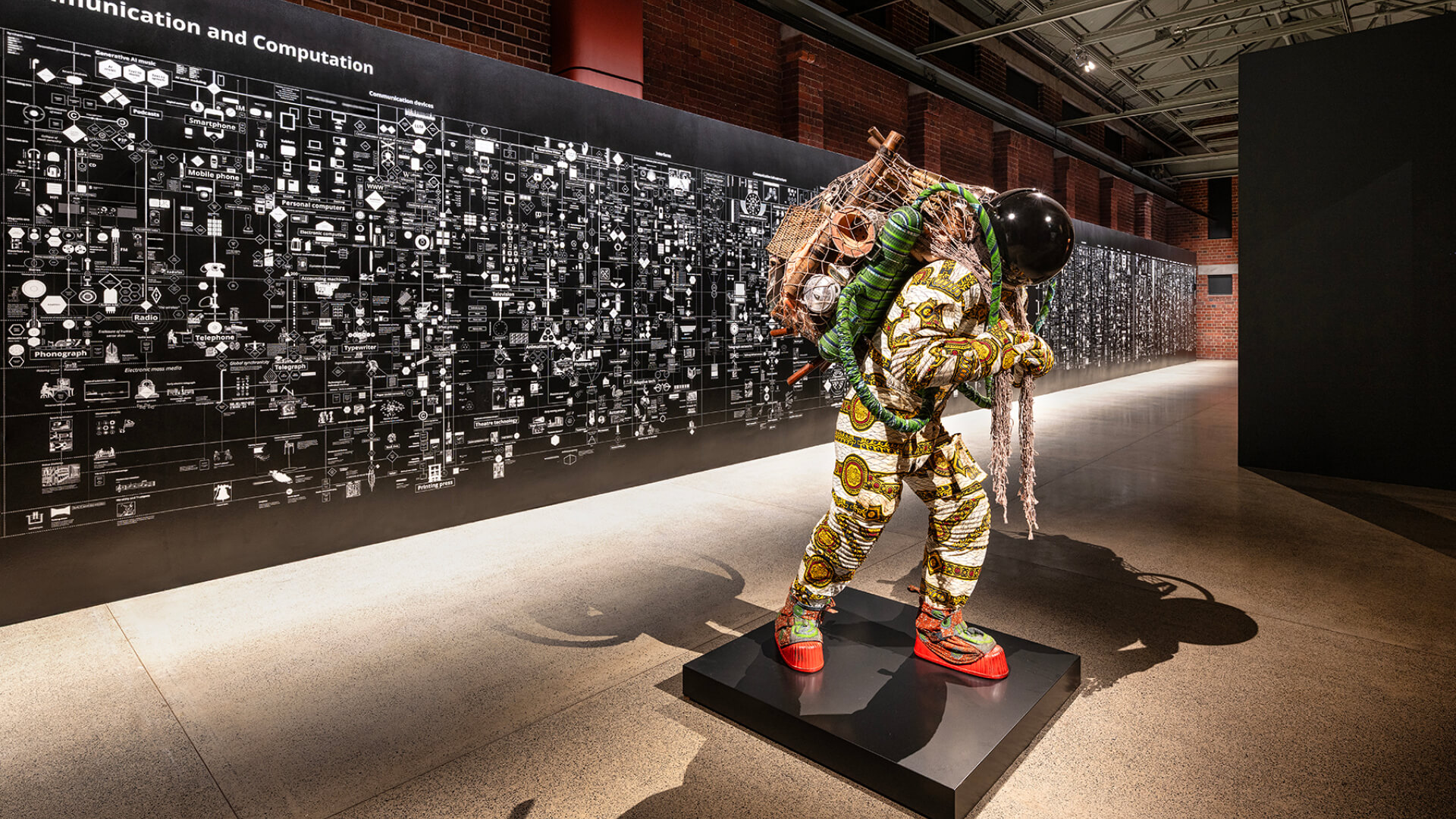
Visitors are confronted at the outset by Calculating Empires, a 24-metre-long data visualisation by researchers and new media artists Kate Crawford and Vladan Joler. Using the visual language of blueprints, technological diagrams and motherboards, the 2023 work maps patterns of colonialism, militarisation and automation from 1500 to the present day. Elsewhere, Yinka Shonibare's Refugee Astronaut X, a life-size fibreglass astronaut clad in African-print textiles, turns the figure of the space explorer from a conqueror planting a flag into someone who has lived through the consequences of conquest.
The show also includes Paula Gaetano Adi's Guanaquerx from 2024 and Kamil Adam Hassim's Event Horizon, a 2026 installation that turns particle physics and astronomy into an embodied, immersive experience. Together, the works use science fiction, data and sculpture to ask who gets to imagine the future, and on whose terms.