Exhibition preview·Venice
Swiss Lesbians Take Over a Cold War Bunker: Nina Wakeford on the Venice Pavilion's Unfinished Business
In a new BOMB interview, artist Nina Wakeford describes how she and five collaborators turned the Swiss Pavilion at the Venice Biennale into an imagined Cold War bunker run by Swiss lesbians. The Unfinished Business of Living Together is on view until 22 November 2026.
Nina Wakeford has described how she and five collaborators transformed the Swiss Pavilion at the Venice Biennale into an imagined Cold War bunker taken over by Swiss lesbians, in an interview published by BOMB Magazine on 16 November. The pavilion project, The Unfinished Business of Living Together, was made by a working group of six, including Luca Beeler, Gianmaria Andreetta, Yul Tomatala and Miriam Laura Leonardi, and remains on view at the 61st Venice Biennale until 22 November. The group built a maze of cold white walls filled with photographs, documents, video, sound and signage.
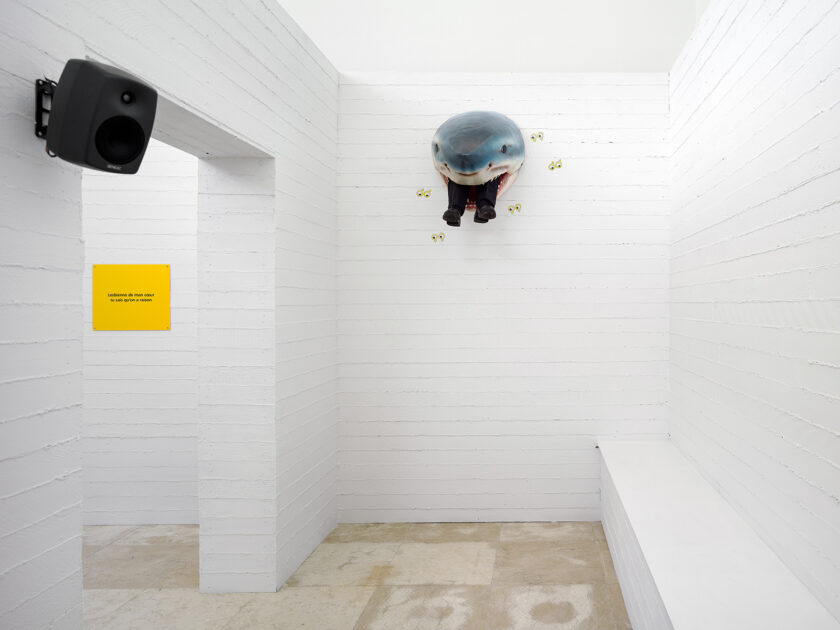
It starts from a 1978 Swiss television talk show in which a studio audience discussed homosexuality, an event Wakeford treats as Switzerland's Stonewall moment. From there she developed a Sculpture Room dedicated to the Swiss lesbians and queer feminists whose histories the pavilion gathers, imagining them occupying a bunker like those the Swiss state built during the Cold War. A shark head borrowed from Swiss broadcaster SRF hangs in the room, ringed by symbols cut from photocopies of a gay magazine, while a door taken from the Swiss Consulate in Venice now stands in a corridor, a reminder of who is allowed inside and who is kept out.
Wakeford came to art from sociology, which shapes how she handles archives. She argues that archives are never neutral: they are selective, full of gaps, and shaped by whoever does the recording. Some material survived through institutional decisions, such as the television footage, while other material survived through collective care, including photographs by Alice Arnold, whose negatives were printed at poster scale for visitors to leaf through. Wakeford wants visitors to feel that difference.
The pavilion also reactivates Swiss film history: Reopening Bar Jeder Frau, made with filmmaker Katrin Barben, doubles Barben's 1991 short film frame by frame, layering new footage over the 16mm original to double the time of lesbian visibility. Across generations, languages and identities, the six collaborators did not always agree, and Wakeford treats that friction as part of the work: the business of the title stays unfinished, by design.