Exhibition preview·Munich
A Journey Through the Dark, Myth-Soaked Painting of Symbolist Franz von Stuck
MutualArt's Benjamin Blake Evemy traces Franz von Stuck's symbolist vision across seven key works — from the wounded Amazon to Sisyphus, Lucifer and The Sin — exploring how the Munich painter fused classical myth with fin-de-siècle anxiety, eroticism and psychological unease.
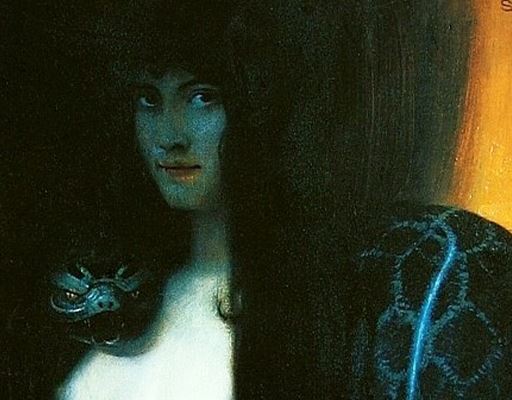
MutualArt has published a deep dive into the work of Franz von Stuck, the German painter, printmaker, architect and sculptor whose mythological canvases helped define Symbolism. Written by Benjamin Blake Evemy, the essay moves chronologically through seven paintings, arguing that Stuck's power lies in transforming familiar myths into uncanny, psychologically charged worlds. The tour begins with Wounded Amazon (1905), now at Harvard Art Museums, which portrays a bloodied warrior sinking to her haunches amid battle with the Centaurs — a scene invented rather than drawn from classical texts — and Sisyphus (1920), held by Munich's Galerie Ritthaler, where the condemned king strains against an infernal-red sky. The Guardian of Paradise (1889), Stuck's first major oil painting and a gold-medal winner at Munich's Glaspalast, depicts a sword-bearing angel before heaven's gate, while Lucifer (1890), in Sofia's National Gallery for Foreign Art, shows the fallen angel in brooding, metallic-blue repose, an oversized teardrop hanging above him. The essay lingers on The Sin (1893) at Munich's Neue Pinakothek, Stuck's most famous image of Eve entwined with a serpent — a motif he repeated in about a dozen versions, and one that earned Carl Jung's praise for its blend of anxiety and lust. Salome (1906) at the Lenbachhaus follows: the dancer under a starfield as a servant presents John the Baptist's severed head. The piece notes that three versions were made in the year of Stuck's knighthood, that one vanished during World War II, and that Stuck was reputedly Adolf Hitler's favorite painter, with some speculating the dictator modeled himself on the 1889 canvas Wilde Jagd. The survey closes with the 1923 Self-Portrait in a private collection, framing Stuck's achievement as a move away from the Neoclassicists' technical exactitude toward fully inhabited painted worlds — ones that first entice the viewer and then, as the essay's title has it, consume them entirely.