Exhibition preview·New York
After Institutions Turned It Down, Miles Greenberg Staged His Six-Hour “WAR” in a Shuttered Cinema
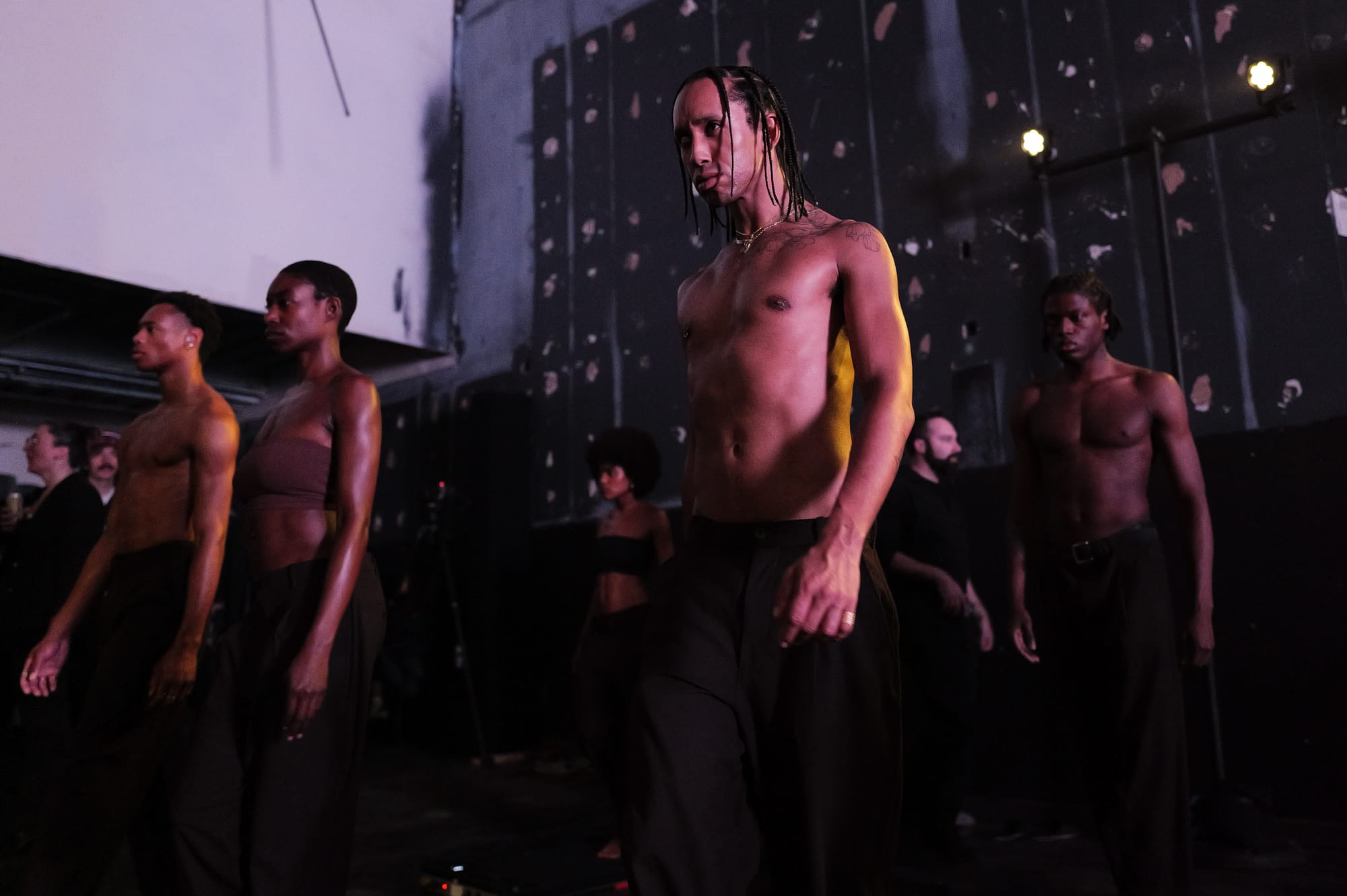
Miles Greenberg’s six-hour performance “WAR”, staged by Performa on 29 October in a vacant former cinema with more than 40 performers walking on treadmills, struggled to find any institutional backer. In a new interview, the artist describes the search for a venue and the work’s roots in his early encounter with Marina Abramović.
When Miles Greenberg set out to stage “WAR”, a six-hour durational performance about war, he found that no outlet, institution or gallery was willing to support it. The work eventually went ahead on 29 October, organised by Performa and curated by Zoe Lukov, in the empty shell of the former 86th Street Cinema in New York, where more than 40 performers walked on treadmills for six hours to a trance-like score by the artist Chino Amobi.
In an interview with Hyperallergic, Greenberg spoke about the difficulty of securing a venue for the piece at a moment when the subject of war, and specifically Israel’s war in Gaza, made institutions wary of association. The performance grew out of a practice shaped early on by an encounter with Marina Abramović: his mother took him to see “The Artist Is Present” at the Museum of Modern Art when he was 12, an experience he describes as the starting point for his own work in performance. He later trained under the playwright Robert Wilson, the choreographer Édouard Lock and Abramović herself.
Greenberg’s performances borrow figures from art history and myth, and he has appeared on plinths as the satyr Marsyas from Greek legend and as Saint Sebastian, the arrow-pierced Christian martyr. He says he is drawn to these archetypes because Western culture has retold them for centuries as a shortcut to moral teaching, and because working inside that visual language lets him place himself in conversation with the canon rather than at its margins. Saint Sebastian, he adds, carries personal meaning for him as a queer artist, and he thinks of these works as portraits rather than acts of identification with the figures.
He describes performance as a gateway into a state that is difficult to reach, and his ambition is for the work to be approached as sculpture, encountered in a museum setting. The interview traces how that ambition collided with the practical reality of “WAR”: a large-scale, durational piece about conflict that institutions were reluctant to host, staged instead in a disused cinema where endurance itself became part of the work’s meaning.