Exhibition preview·New York
Maia Ruth Lee's 'Double Vision' Turns Translation Into Bodily Experience
In her Tina Kim Gallery solo show Double Vision, Maia Ruth Lee draws on her parents' Bible translation work in Nepal to treat translation as a physical, imperfect act of migration across materials.
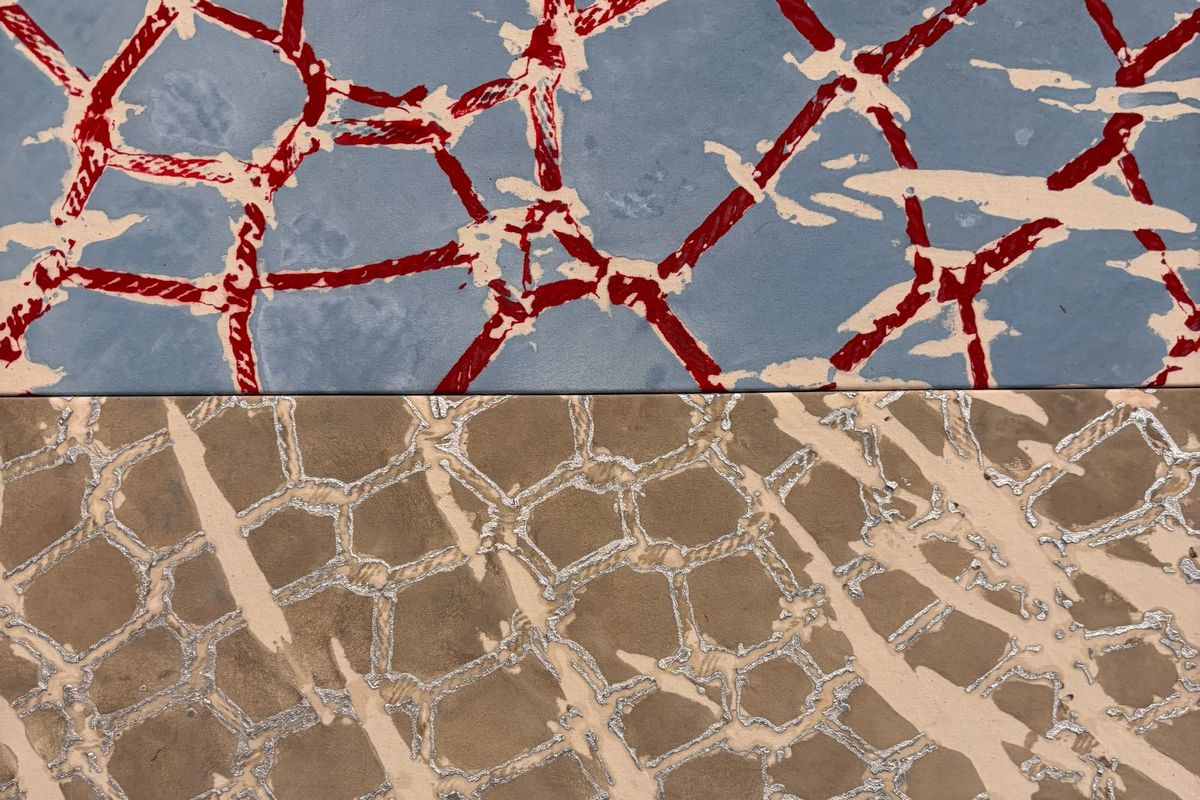
In Double Vision, Maia Ruth Lee's solo exhibition at Tina Kim Gallery, translation never quite arrives — it is instead a condition to be embodied and probed. The artist, whose parents were Bible translators who moved to Nepal and developed a written alphabet for the oral Sherpa language, treats translation as a kind of migration: some things carry across, others are left behind. Grid-like patterning inspired by the luggage at Kathmandu airport, illegible glyphs, and images from the family archive form a recurring visual language across canvas, latex, and steel. The works draw on motifs of migration, but the motifs themselves migrate across the gallery, mutating as they take on new forms. In the modular canvases of the B.B. Tetris series (all 2026), stacking reads as playful; in "Expandable Luggage" (2026), the growing height suggests something heavier — a belabored migration. The contrast lets weight and play coexist within the same formal vocabulary, and the gallery installation itself reinforces this mutability: works are grouped so that patterns migrate from one piece to the next, as if the exhibition were a single sentence being reworded. A video work rounds out the presentation, extending the show's logic into time-based media and anchoring its concern with language as lived, physical process. Hyperallergic's pocket review frames Double Vision as an exhibition about the mechanics of carrying meaning between worlds — from Nepal to New York, from language to image — where the gaps and losses of translation become the subject itself rather than its failure.