Exhibition preview·Abu Dhabi
Abu Dhabi museum pairs Gulf and Indian artists for the sixth edition of its Art Here prize
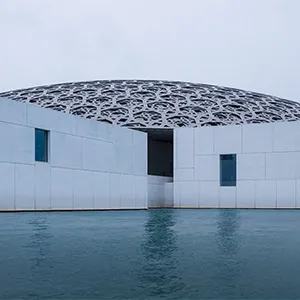
Louvre Abu Dhabi has revealed the six shortlisted artists for Art Here 2026 and the Richard Mille Art Prize, following a review of more than 300 proposals. The 2026 edition is the first to include artists from India alongside those from the Gulf, under the guest curatorship of Kamini Sawhney and the theme 'Confluences'. The shortlisted works go on view beneath the museum's dome from 11 November 2026 to 28 February 2027; the US$60,000 prize winner is announced in December 2026.
Six artists from the Gulf and India will show beneath the dome of Louvre Abu Dhabi from 11 November 2026 to 28 February 2027, after a review of more than 300 proposals. The announcement, made public in early October, marks a deliberate expansion: earlier editions drew on artists from the UAE, the GCC and the wider region, while the 2026 call specifically welcomed Indian artists for the first time, reflecting centuries of commercial and cultural movement across the Indian Ocean. The six artists include Saudi Arabia's Ahaad Alamoudi, whose work probes history, representation and visual language in a changing Saudi Arabia; Emirati painter Almaha Jaralla, who works in textile and pigment on memory and inherited histories of the Arabian Peninsula and the wider Indian Ocean; Dubai-based Malaysian artist and designer Muhammad Shamin Sahrum, who maps everyday urban life through migration and community; and the Indian contingent of Ravikumar Kashi, Reena Kallat and Vivek Vilasini. Kashi brings an interdisciplinary rigour across media; Kallat examines political and social borders and their effects on land and people; and Vilasini explores structures of knowledge, politics and identity in digital and sculptural form. The edition is guest-curated by Kamini Sawhney, the former founding director of the Museum of Art and Photography in Bengaluru, who described the proposals as unusually courageous in their experiments with new ideas, materials and forms. The theme, Confluences, treats culture as layered and continually remade through movement, encounter and return — taking in migration, separation and longing alongside resilience and regeneration. The commissioned works will be developed as site-specific installations across the museum's central plaza, from the Damascene fountain toward the shallow pool and Jenny Holzer's public art wall. One artist will receive the Richard Mille Art Prize, worth US$60,000, with the winner announced in December 2026. Tilly Harrison, managing director of Richard Mille Middle East and Türkiye, framed the edition as an encounter between inheritance and imagination, arguing that culture evolves when different ways of seeing the world meet and reshape one another.