Exhibition preview·London
Only 4% of London's Monuments Honour Women. Two New Sculptures Are Changing That
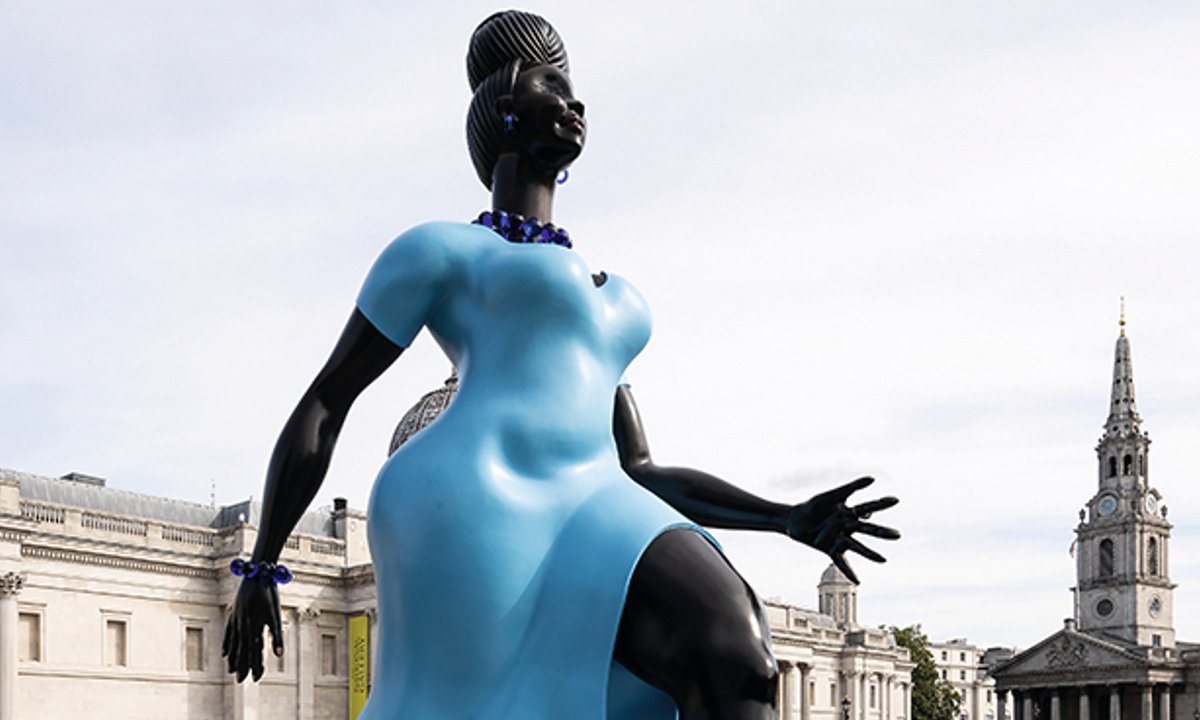
Tschabalala Self's Lady in Blue on Trafalgar Square's Fourth Plinth and Nicole Eisenman's Stack outside the Royal Academy are being held up as signs of change in a city where only 4% of public monuments are devoted to named women.
London is a city of statues of men. Only four per cent of its public monuments are devoted to named women, according to the charity Art UK. But two radical new works by women artists, in two of the capital's most male-dominated locations, are being held up as signs that the balance is shifting.
In Trafalgar Square, surrounded by monarchs and militia and overlooked by Admiral Nelson atop his 51-metre column, Tschabalala Self's Lady in Blue cuts a distinctive figure on the Fourth Plinth. The painted bronze, a five-metre-tall woman in a tight blue dress and matching heels, was unveiled in September as the 16th Fourth Plinth commission. Self has described the work as a contemporary representation of personhood, a woman walking forward into the collective future, not an idol to venerate or a historic figurehead. The figure will stand in the square for two years before going to a permanent home in Fornebu, Norway.
A few streets away, outside the Royal Academy of Arts on Piccadilly, the New York-based artist Nicole Eisenman has erected Stack, a work more than eight metres tall. The Royal Academy, in its 258-year history, has shown only two living women in its main galleries, making the towering sculpture in its courtyard a pointed presence.
In strikingly different ways, the two works offer alternative monuments to aspects of life that rarely get acknowledged in public sculpture, and most notably to the power of women of all ages and from all origins. The shift is recent: in the four years since Art UK's survey, more statues of women have been unveiled in London than in the whole of the second half of the 20th century, from Maggi Hambling's Mary Wollstonecraft to a small bronze of the suffragist Fanny Wilkinson in Wandsworth.