Exhibition preview·New York
Wangari Mathenge Pairs New Paintings with First Sculptures at Lévy Gorvy Dayan
Lévy Gorvy Dayan presents Wangari Mathenge: Re-membering, the artist's first solo exhibition with the New York gallery, introducing five new paintings alongside her first publicly exhibited sculptures, on view through October 24.
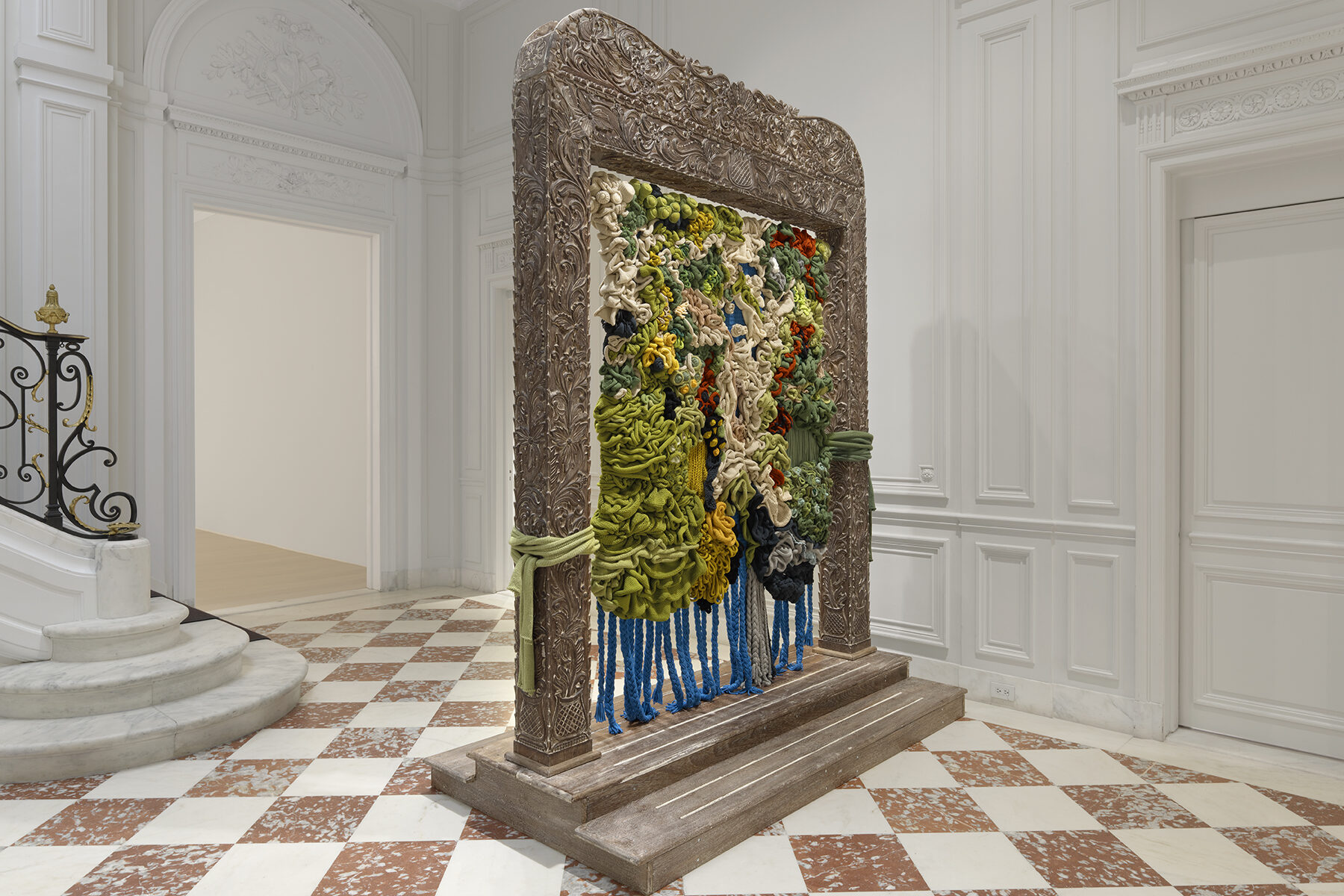
Lévy Gorvy Dayan in New York is presenting Wangari Mathenge: Re-membering, the artist's first solo exhibition with the gallery, on view through October 24 at 19 E. 64th Street. The show introduces five new paintings alongside Mathenge's first publicly exhibited sculptures, extending a series she began in 2024 into two and three dimensions. Across both mediums, she treats history less as something to reproduce faithfully than as material to work with. The project takes its name and part of its intellectual framework from Ngũgĩ wa Thiong'o's 2009 book Something Torn and New: An African Renaissance. Mathenge began by studying Kenyan colonial literature and cultural objects spanning 1900 to 1963, the year Kenya gained independence from the United Kingdom, questioning how both history and her own cultural identity had been constructed. In the new paintings, women serving as avatars for the artist occupy richly layered 1960s domestic interiors crowded with objects, textiles and cultural references that act as personal and historical markers. Two sculptural works carry the idea of reconstruction beyond the canvas. Re-membering VIII (Before Us, After Us, Ever Changing) pairs a hand-carved wooden doorframe made by artisans in Malindi, Kenya, with a densely embellished macramé textile created with the help of Mathenge's family and community, drawing on the carved doors of Lamu Old Town while the textile evokes an imagined, shifting landscape. Re-membering IX (The Shape of Inheritance), displayed on a dress form, is a voluminous knitted sculpture that reinterprets historical Gikuyu dress while folding in colonial references such as the Victorian bustle and train, knitted collaboratively with community members. Re-membering, Mathenge explains, signifies not merely the act of recall but the active gathering and reassembly of what has been fragmented: cultural memory, inherited forms, histories and ways of seeing. The exhibition reads as much about what can be carried forward as what has been lost, with bodies becoming landscapes and inherited forms taken apart and assembled again.