Exhibition preview·Los Angeles
Leon Polk Smith's Hard-Edge Abstractions Return to Los Angeles After More Than a Decade
Lisson Los Angeles and Marc Selwyn Fine Art present concurrent exhibitions of Leon Polk Smith, the hard-edge abstraction pioneer's first solo show in Los Angeles in more than a decade. Opening 20 November, the two-gallery presentation brings together more than twenty paintings and works on paper from the mid-1950s through 1980, several never before exhibited.
More than a decade after his last solo show in Los Angeles, Leon Polk Smith is back in the city with a two-gallery survey of his hard-edge abstraction. Lisson Los Angeles and Marc Selwyn Fine Art present Line, Color, and the Concept of Space, which opened on 20 November at 1037 North Sycamore Avenue, bringing together more than twenty paintings and a selection of works on paper from the mid-1950s through 1980.
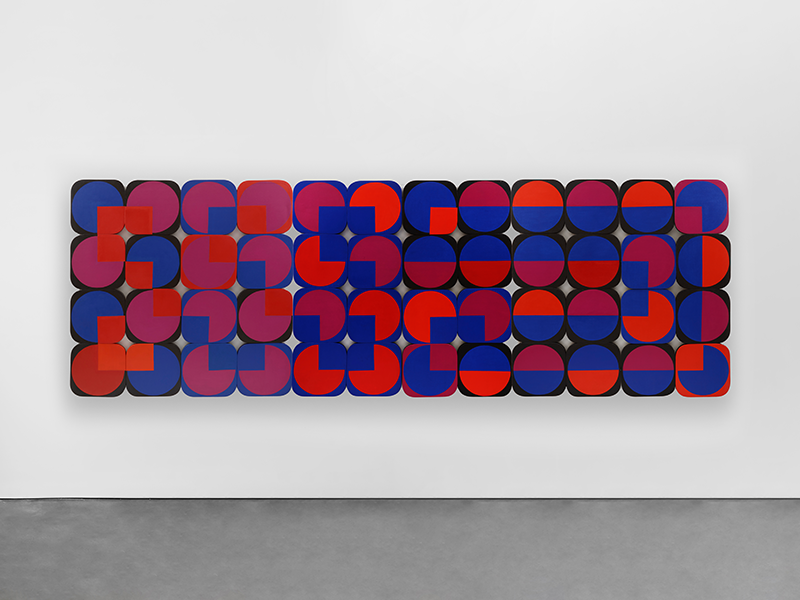
Smith (1906-1996) was one of the founders of hard-edge abstraction, and his discovery was a single curving line that splits a canvas into two spaces, letting figure and ground trade places. That device produced the Correspondences of the late 1950s and early 1960s - large shaped canvases holding two bright shapes - and, from about 1967, the Constellations, round and multi-panel paintings.
At Lisson, works including Inca (1970), Red Triangle, Black Square (1968) and Stretch of Black II (1961) foreground the relationships between individual shapes and larger compositions, while Marc Selwyn shows Romance of the Spheres (1963) and Rising Red (1980), highlighting curved forms and spatial tension. Several works in the two presentations have never been exhibited before. The presentations share a common focus on Smith's sustained exploration of geometry and space, while offering distinct perspectives on his practice.
As Smith once recalled, he 'set out from Mondrian to find a way of freeing this concept of space so that it could be expressed with the use of the curved line as well as the straight.' The joint presentation traces how that ambition sustained a rigorous and inventive language of geometric abstraction across three decades.