Museum report·Kyoto
Kyoto Museum Revives Hand-Woven Brocade Pioneer Yamaga Seika in First Retrospective in Four Decades
Kyoto City KYOCERA Museum of Art hosts the first major retrospective in 40 years of textile artist Yamaga Seika (1885-1981), pioneer of hand-woven brocade, on view until 20 December 2026.
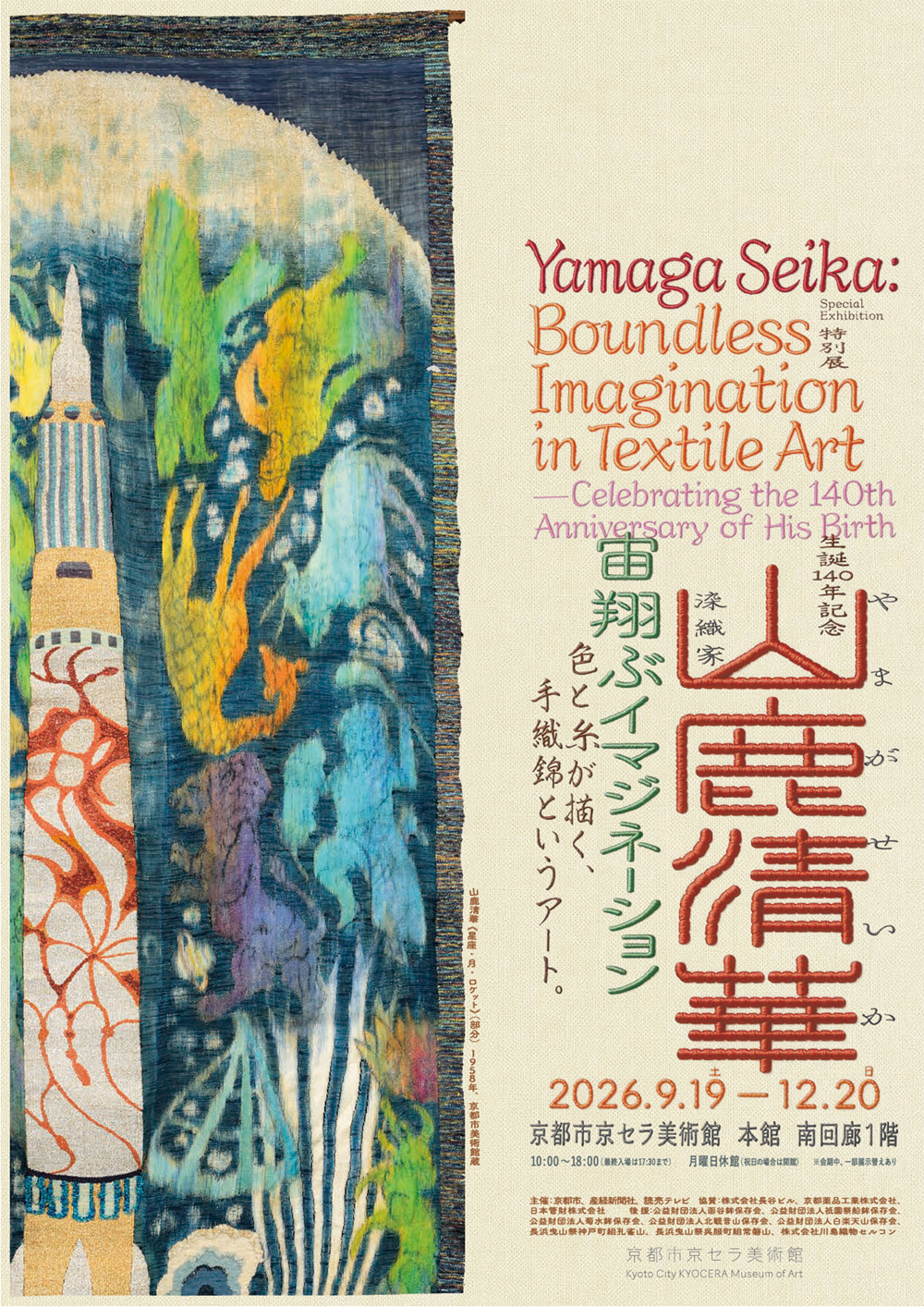
The Kyoto City KYOCERA Museum of Art is presenting the first large-scale retrospective of Yamaga Seika in forty years. Titled for the 140th anniversary of the artist's birth, 'Textile Artist Yamaga Seika: Cosmic Imagination' runs from 19 September to 20 December 2026 in the museum's Main Building South Wing, and is organized in six chapters tracing a career that ran from the Meiji era into the late Showa period. Yamaga (1885-1981) was born into one of Kyoto's oldest letterpress printing families and apprenticed at fifteen to a Nishijin textile designer before studying under the celebrated designer Kamisaka Sekka. His breakthrough came in 1927, when his 'Handwoven Brocade: Dutch Ship' won a special prize at the Imperial Art Exhibition, the Teiten, in the year its arts-and-crafts category was newly established. That success pushed him to commit fully to textile art, and he went on to develop teori-nishiki, a hand-woven brocade method in which the artist controls the entire production process from design to loom. The retrospective shows how far Yamaga pushed the medium beyond the loom. Alongside early designs such as the 'Dutch Ship' study, it includes experimental pieces made with unconventional materials, including 'Fighting Kangaroo' from 1960, and the monumental 'Constellations, Moon, Rocket' from 1958, a work that points his cosmic imagination toward the space age. His commissions ranged from festival decorations and votive hangings to hotel interiors and the decoration of luxury ocean liners, and in 1969 he received the Order of Cultural Merit. For Kyoto, a city whose identity is bound up with textile craft, the show is also a homecoming. It reframes Yamaga not as a craftsman working inside tradition but as an artist who insisted textiles could stand as an independent art form, a claim the six-chapter structure sets out to prove work by work.