Market dispatch·New York
US$80M top estimate puts Kandinsky's Betonte Ecken on course to shatter his $44.8M auction record
Christie's will offer Wassily Kandinsky's Betonte Ecken (1922–23) at its 20th Century evening sale in New York on November 17 with an estimate of $60–80 million, which would demolish the artist's current auction record. The painting carries a storied provenance: it was the first Kandinsky acquired by Hilla Rebay, the Guggenheim's founding director.
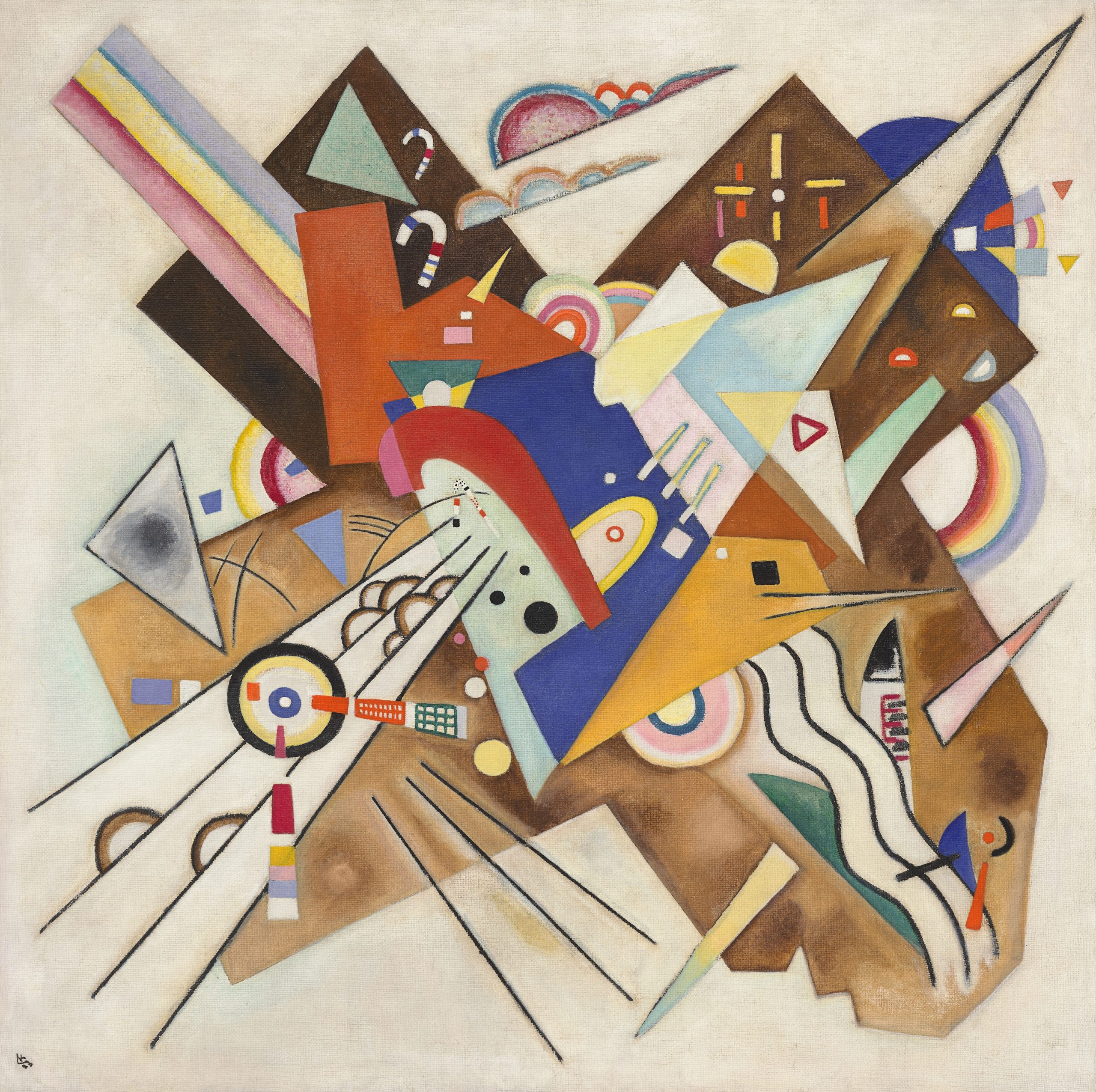
Christie's will offer Wassily Kandinsky's Betonte Ecken (1922–23) at its 20th Century evening sale in New York on November 17 with an estimate of $60 million to $80 million. A sale anywhere within that range would demolish the artist's current auction record: the £37.2 million ($44.8 million) paid for Murnau mit Kirche II (1910) at Sotheby's London in 2023.
The painting, whose German title translates as "Accentuated Corners," was made in Weimar shortly after Kandinsky joined the Bauhaus at Walter Gropius's invitation. Its rigid geometries and blocks of primary color show the school's imprint, while the black parallel lines across the surface gesture to another lifelong influence: music. After hearing Wagner at the Bolshoi Theatre in 1896, Kandinsky came to believe colors carried inner sounds — blue akin to the cello, pure green to the calm tones of the violin — and attempted to set melody, rhythm and harmony onto the canvas. The work is considered a direct forerunner of Komposition VIII (1923), now in the Guggenheim's collection.
The provenance adds to the allure. The picture comes from an anonymous European collection and was the first Kandinsky acquired by Hilla Rebay, the co-founder and first director of the Guggenheim, whose devotion to non-objective art had been shaped by Kandinsky's treatise On the Spiritual in Art. Rebay met the artist in Dessau in 1930; the Guggenheim bought Betonte Ecken from her in 1941 and sold it in the mid-1960s. Paige Kestenman, co-head of Christie's 20th century evening sale, called it "the best example from this seminal moment" to appear on the market in decades. It follows Das bunte Leben (1907), which fetched £31.6 million ($41.8 million) as the headline lot of Christie's London sale — the third-highest Kandinsky price ever recorded.


