Museum report·Mumbai
Jitish Kallat Brings a 1950s Plan to Bomb the Moon to Mumbai in Cosmic Solo Show
Jitish Kallat's Conjectures on a Paper Sky has opened at the Dr Bhau Daji Lad Museum in Mumbai, a cosmic survey ranging from a once-secret American plan to detonate a nuclear device on the Moon to 365 drawings tracking a year of births and deaths.
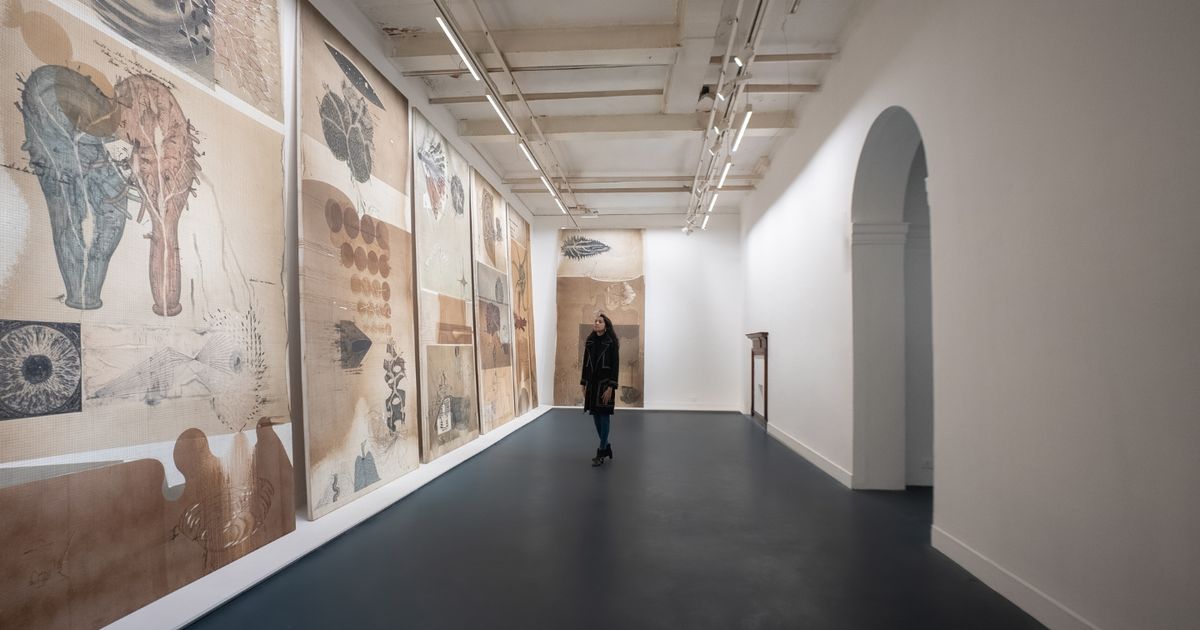
Jitish Kallat's major solo exhibition Conjectures on a Paper Sky has opened at the Dr Bhau Daji Lad Museum in Mumbai, where it runs until 14 February 2027. Presented with the Kiran Nadar Museum of Art and curated by Alexandra Munroe, the show asks what human history looks like when viewed against the scale of the cosmos, moving between science, political power, technological ambition and human vulnerability.
The exhibition takes its title from a ten-part suite of paintings made between 2023 and 2025, developed from research into Project A119, a once-classified 1950s American proposal to detonate a nuclear device on the Moon. Across hand-drawn grids, Kallat layers ballistic trajectories and blast-like forms with botanical, geological, suboceanic and celestial imagery, letting documented fact and speculation share the same picture plane.
In the museum's main hall, Moon Treaty (2025) expands into 54 sculptural forms derived from the 1979 United Nations agreement governing activity on the Moon and other celestial bodies, its crumpled treaty sheets reimagined as small planets. Outside, Untitled (Two Minutes to Midnight) (2018) joins enlarged forms based on Palaeolithic hand axes — among humanity's earliest tools — with a wedge shaped by the gap between the hands of the Doomsday Clock, which stood at two minutes to midnight when the work was made.
The Mumbai presentation, the second iteration after a first showing in New Delhi in February 2026, adds new bronze sculptures and works including Lunar Redux, Epicycles and the Albedo (Point of Incidence) paintings. For the first time, all 365 drawings from Integer Study (drawing from life) (2021) are shown together: made daily through 2021, each begins with algorithmically estimated figures for the global population and the births and deaths recorded so far that day, turning demographic data into a meditation on life, death and time.