Exhibition preview·New York
Jane Benson Cuts Frankenstein's Monster Free in a Feminist Reworking at Sargent's Daughters
BOMB magazine's studio visit follows Jane Benson's "her her*", a body of work that cuts, fragments and reconstitutes Mary Shelley's Frankenstein manuscript to rescue the monster's voice from Dr. Frankenstein. The show is on view at Sargent's Daughters in New York until December 5.
In a studio visit published by BOMB magazine, writer Molly Murray follows artist Jane Benson through the making of "her her*", a body of work that takes Mary Shelley's Frankenstein apart and puts it back together as a feminist act of recovery. The work is on view at Sargent's Daughters in New York until December 5.
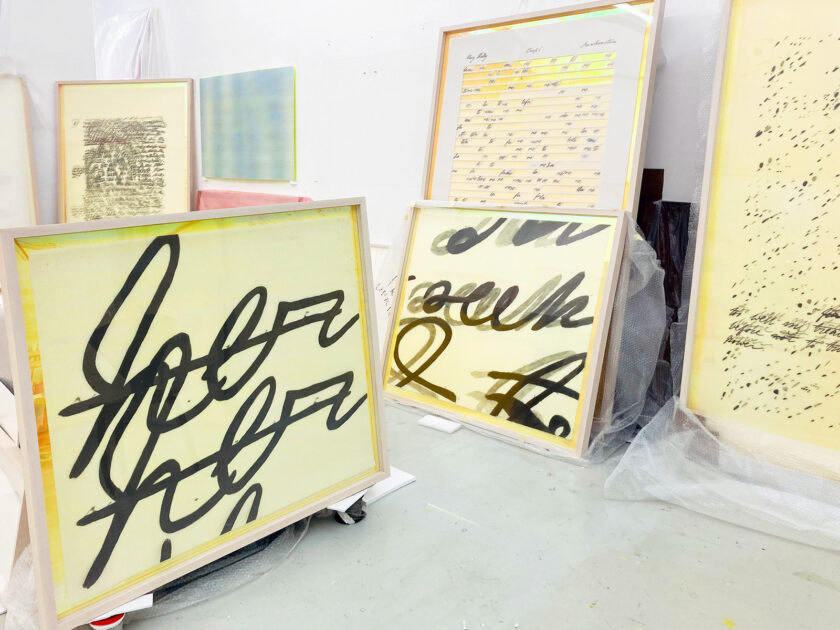
Benson's vocabulary centres on the cut. In her Chelsea studio, huge graphite-on-paper renderings enlarge the original manuscript of Frankenstein, specifically the passages in which the monster speaks, and Benson then subjects them to forms of excision. On some pages she cuts away the prose narrative to reveal haunting lyric phrases; on others she removes every pen stroke, leaving only the negative spaces inside the letterforms to make a new visual rhythm; on others still she deletes every syllable except the notes of the musical scale, so that patterns of "do, re, mi" suggest a secret, unheard melody. The point, she explains, is not defacement but rescue: freeing the monster, and Shelley herself, from the mad male egotism of Dr. Frankenstein.
The cutting also makes sound. The text works are framed behind radiant iridescent plexiglass, and a small speaker plays a soprano, Hai-Ting Chinn, singing music composed from the notes and patterns of the cut text. Visual reduction creates sonic plenitude, filling the studio with what Murray calls an impossible chorus belonging at once to Shelley, to the monster and to Benson.
A final group of works turns from the manuscript to trees. Benson shows large graphite drawings of elms that she has transplanted from Shelley's marginal doodles, imaginatively grafting them onto the beloved, long-dead elms of her own English childhood, remembered through a set of lost photographs by her late father. The shimmering, phantom leaves close a body of work built on rupture and renewal, in which fragmentation becomes a way of listening to voices the original novel left buried.