Exhibition preview·Miami
Pipe Cleaners, Emergency Blankets and Clay: Miami Show Recasts Basketry as Open-Ended Art
A new group show at Mindy Solomon Gallery in Miami treats basketry as an open-ended artistic language rather than a fixed craft. Interwoven: Basketry As Expanded Practice, curated by Dee Clements, opens on 29 November and runs to 9 January 2027.
A forthcoming exhibition at Mindy Solomon Gallery in Miami asks what happens when basketry is understood not as a fixed category of craft but as an open-ended artistic language. Interwoven: Basketry As Expanded Practice, curated by Dee Clements, opens on 29 November and continues through 9 January, bringing together nearly two dozen artists who use weaving techniques in unexpected directions. The show sets out to break with craft tradition, positioning basketmaking as a way of thinking that can stretch across sculpture, painting and installation.
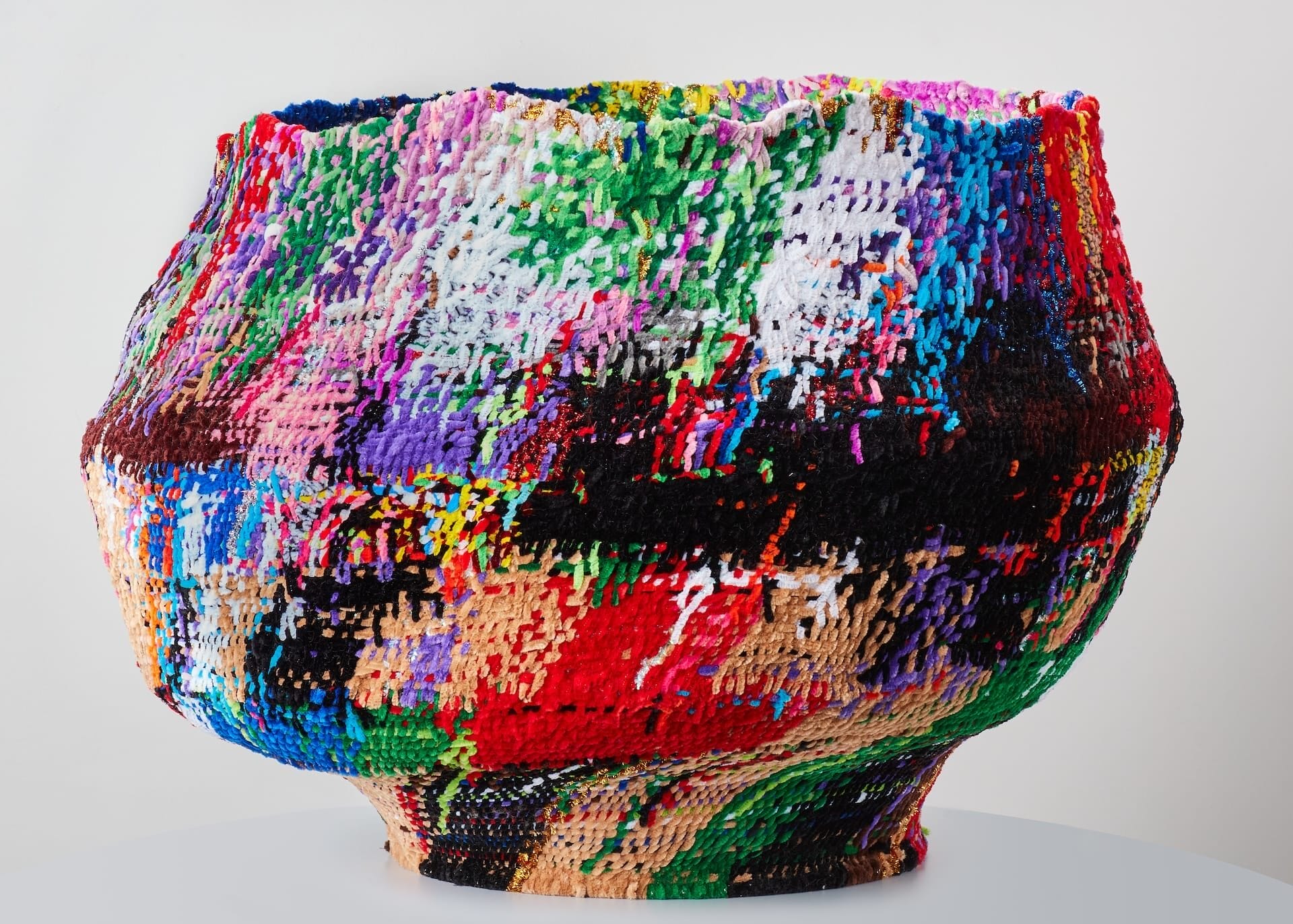
The artists work with materials far removed from the straw or willow of a garden trug. Salvador Dominguez, working with Silvia Dominguez, makes vivid vessels from pipe cleaners, while Eric Gushee builds intricately interlaced sculptures from aircraft cable and steel rebar ties. Miguel Arzabe weaves deconstructed paintings back together into wall works, and Jose Santiago Perez sews Mylar emergency blankets into shimmering, tent-like forms. Dienke Dekker works in paper and cane, Jessy Nite in paracord and hemp, and Xanthe Sommers in glazed stoneware, each testing how far a woven structure can travel from its functional origins.
Clements, the curator, contributes her own ceramic and woven-reed piece, Crone, and Sonia Barrett extends the conversation into furniture, attaching willow and netting to a Chinese lacquer desk. The range of the show is its argument: basketry is not a single technique or a single object, but a set of gestures, looping, knotting, threading and containing, that artists can apply to almost any material. A basket, in this framing, is less a container than a structure for holding ideas.
The exhibition arrives as craft practices continue to gain ground in contemporary art spaces, with makers who once sat outside the gallery system increasingly shown on equal terms with painters and sculptors. By gathering such a wide spread of approaches under one roof, Interwoven makes the case that the distinction between craft and art says more about old hierarchies than about the work itself.