Exhibition preview·London
Swiss artist Renée Levi gives Hayward Gallery a bold new skin for autumn
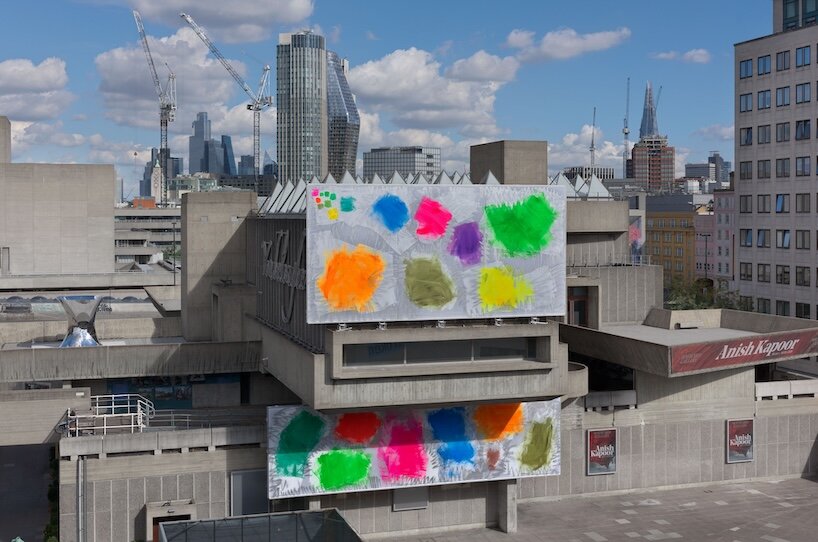
Renée Levi's 'September', an Audemars Piguet Contemporary commission, covers the Hayward Gallery's London facade from September to 15 November 2026.
The Hayward Gallery on London's South Bank is spending this autumn behind a new face. Swiss artist Renée Levi has draped the institution's celebrated Brutalist facade in 'September', a large-scale commission created with Audemars Piguet Contemporary, on view until 15 November 2026. The work is Levi's first large-scale public installation in the UK, and it takes the form of a two-panel painting hung above and below the building's distinctive protruding window, the feature often described as the Hayward's 'eye'. Rather than placing an object in front of the architecture, Levi works with it directly, treating the concrete surface and the window as part of the composition. Fluorescent greens, pinks, blues and oranges bring loud company to one of the South Bank's best-known grey surfaces. Levi's approach to painting is shaped by the body, the material and the site rather than by a predetermined image. Here her gestures expand across the facade while remaining tied to the physical reach of the painter herself. The painting surface is industrial mesh, a material Levi is using for the first time: typically associated with large-scale advertising and signage, it lets air pass through while carrying her oversized marks, a small subversion of a surface more used to selling things than being the artwork. For Audemars Piguet Contemporary, the commission marks a first of its own. Although the watchmaker's art programme has been commissioning artists across media since 2012, working with figures including Cao Fei, Adrián Villar Rojas and Ryoji Ikeda, 'September' is its first painting commission. For Levi, it extends a practice of architectural-scale interventions that has previously occupied Palais de Tokyo, Kunstmuseum Basel and the Lyon Biennale. Unlike a painting met inside a gallery, 'September' refuses a single frontal view. It shifts with distance, angle, daylight and shadow, folding itself into the constant circulation of people along the South Bank. For its eight-week run, commuters and tourists become its repeat audience, whether or not they planned on seeing contemporary art that day. When the run ends, the colour disappears and the Brutalism gets its grey back.