Exhibition preview·Santa Fe
Esther Elia Turns Ancient Assyrian Guardians into Tile-Covered 'Diasporic Deities'
Albuquerque-based artist Esther Elia reimagines the lamassu — the winged guardians of ancient Assyria — as contemporary, tile-covered figures in her solo show Bazaar Ashuraya at Hecho a Mano in Santa Fe, running 6–29 November, alongside paintings that dress Assyrian life in today's fashions.
In ancient Assyria, lamassu — winged bulls and lions with human heads — stood guard over cities and palaces. For Albuquerque-based artist Esther Elia, who is of Assyrian and Irish descent, those guardians are not relics of a distant past. Her new solo exhibition, Bazaar Ashuraya, at Hecho a Mano in Santa Fe, reimagines them as vivid, contemporary figures dressed in the fashions of today.
The show, which runs from 6 to 29 November, brings together acrylic paintings, tile mosaics and functional objects built around the idea of home. Elia describes the home as the place where Assyria lives and breathes: the room where the language is spoken, the food is cooked and customs are kept alive and pushed forward. Her paintings borrow the framing and patterning of Persian rugs, then fill them with figures in Adidas trainers, Farm Rio prints and vintage dresses, in works with titles such as Sharrat Wearing Adidas and Esther and Zahra Wearing Farm Rio.
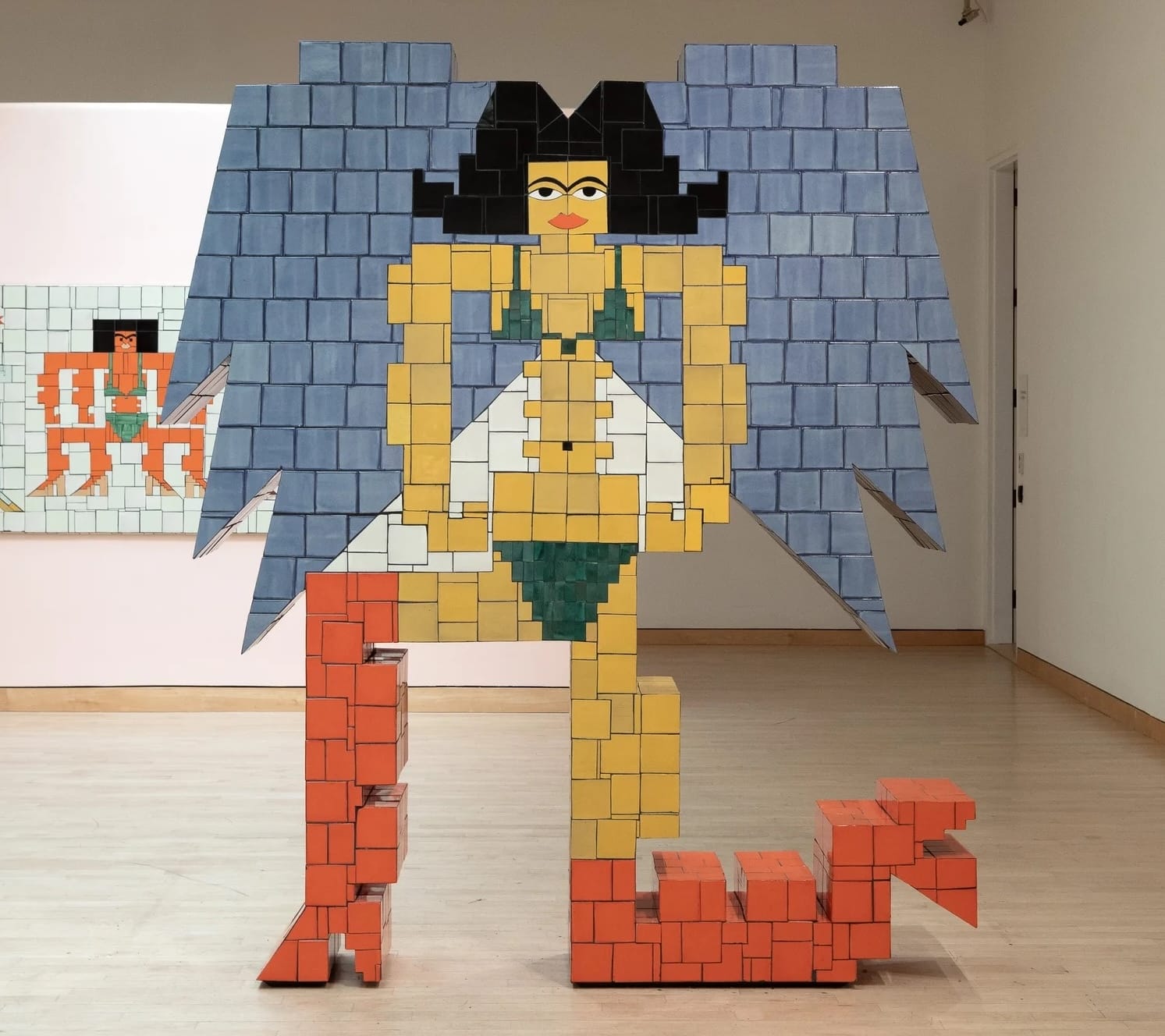
Her sculptures carry the same idea into three dimensions. Nearly life-size figures coated in Mexican tiles, cement board and plywood stand on wheels so they can be moved and rearranged, and Elia calls them diasporic deities — protectors built from materials found in the American Southwest and designed to adapt to new spaces. Malikta Protective Deity, made in 2023, rises eight feet tall with blue wings and red boots, while other figures take the form of lamps and murals.
The exhibition arrives as Elia's profile grows: she was recently named a 2027 resident of the John Michael Kohler Arts/Industry programme, run by the John Michael Kohler Art Center and Kohler Co. in Wisconsin. Bazaar Ashuraya turns a story of displacement into one of continuity, arguing that a culture survives not in a museum case but in the daily life of a household — in its clothes, its furnishings and the food on its table.