Museum report·Florence
Climb the scaffold: Florence lets visitors stand centimetres from Castagno's 1447 Last Supper as restorers work
From 15 November 2026, visitors to Florence's Cenacolo di Sant'Apollonia can climb a purpose-built scaffold and view Andrea del Castagno's Last Supper fresco at close range while its restoration is under way, with the Opificio delle Pietre Dure supporting the scientific work.
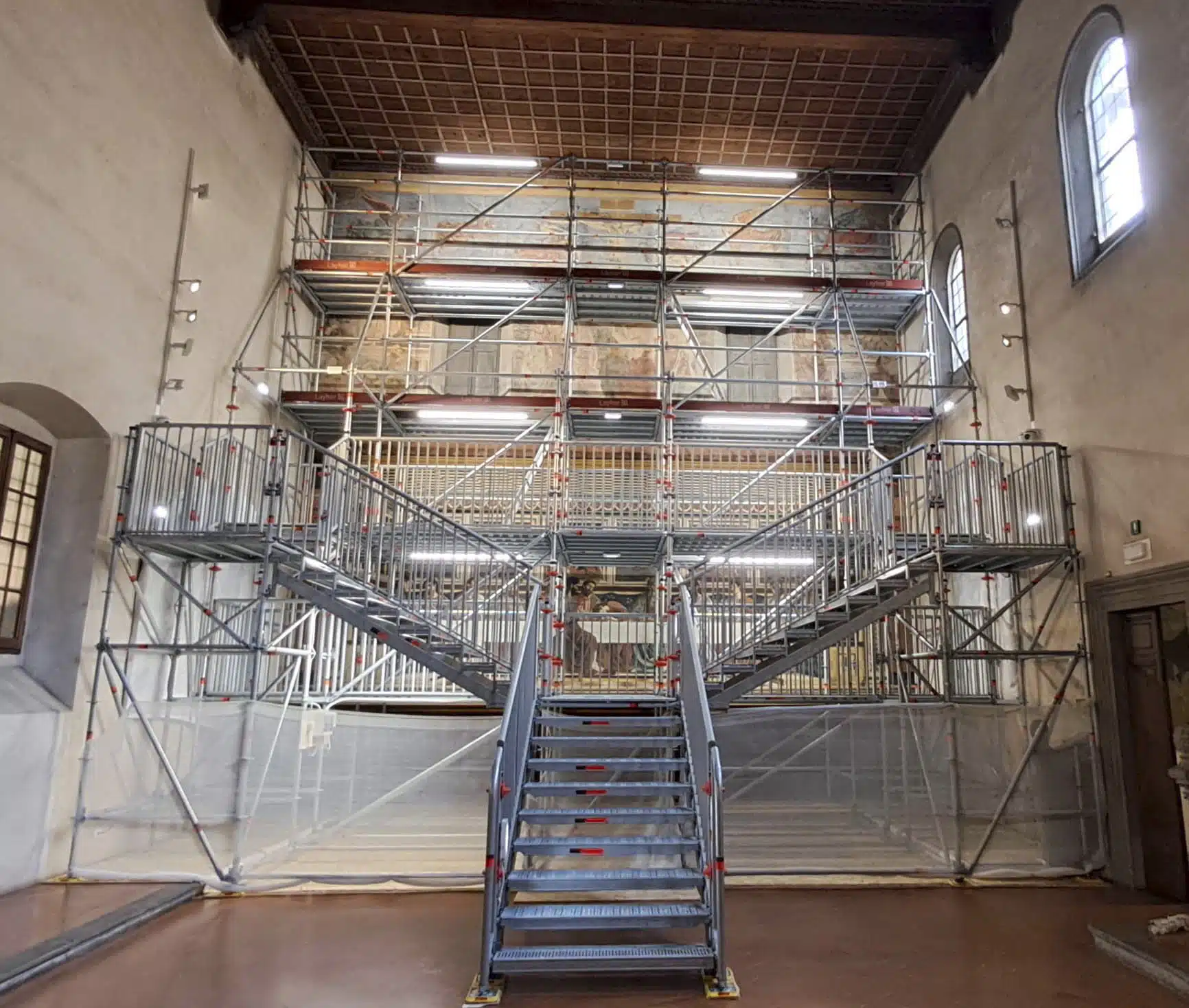
Florence has turned a conservation site into a public experience. From 15 November 2026, visitors to the Cenacolo di Sant'Apollonia can climb a specially built scaffold and stand a few centimetres from Andrea del Castagno's Last Supper, a fresco painted around 1447, while restorers work on the wall beside them. The arrangement runs until 26 June 2027, and small groups can book 30-minute visits to the platform.
The fresco fills the former refectory of a Benedictine convent founded in 1339. Castagno covered the hall with scenes from the Passion and the Resurrection, placing the Last Supper at the lower level, beneath the Resurrection, the Crucifixion and the Entombment. The table scene is built around a perspectival room, with painted marble panels, a patterned ceiling and a geometric floor that give the gathering of Christ and the apostles an unusual sense of depth. From the scaffold, visitors can inspect the painted architecture and figures at a distance impossible from the floor.
The conservation work is coordinated by the Regional Directorate of National Museums of Tuscany, through the Museum of San Marco and the Cenacoli museums, with scientific and methodological support from the Opificio delle Pietre Dure, Florence's state conservation institute. The local heritage authority and Italy's National Research Council are also involved, and the Isabel and Balz Baechi Foundation is contributing funding and operational support. Alongside the treatment, specialists are studying the pigments, the painting technique and earlier interventions, aiming to make the cycle easier to read while preserving its surviving original material.
The paintings spent centuries largely unseen: the nuns' strict enclosure kept outsiders out, and even the 16th-century biographer Giorgio Vasari left the cycle out of his account of Castagno. Only after the convent was suppressed in the 19th century did the frescoes become accessible, and a museum dedicated to the artist opened there on 1 April 1891. The three upper scenes were detached in 1953 and moved to new supports, revealing preparatory drawings that are now shown on the opposite wall. Scaffold tickets cost 8 euros, or 4 euros for visitors up to 25, and guided visits begin on 21 November.