Market dispatch·London
$3.18M Riley Canvas Misses Estimate but Still Up 79% Since 2007
Bridget Riley's 1969 Byzantium sold for $3.18 million at Christie's London on October 14 — under its low estimate but 79% above its 2007 price, a 3% annualized return.
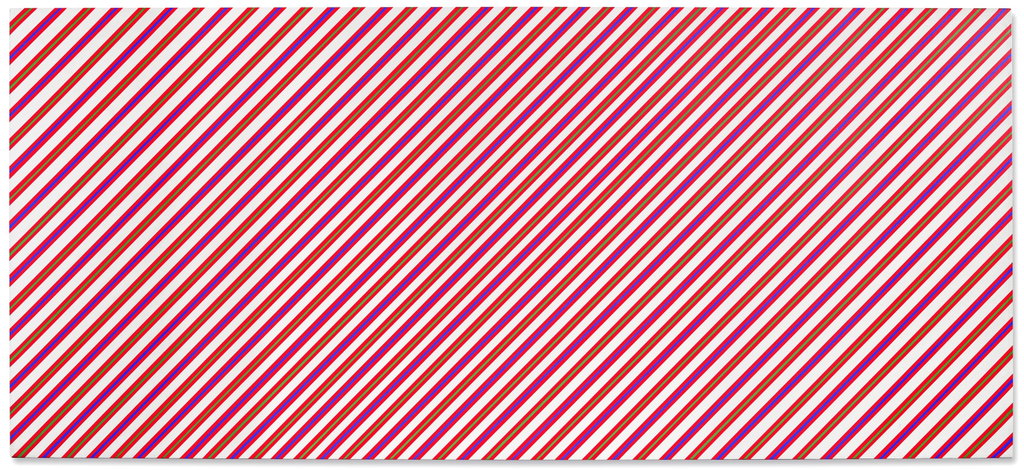
Bridget Riley's Byzantium, a 1969 op-art canvas, sold at Christie's London on October 14 for $3.18 million — below its low estimate, but 79 percent above what the same painting fetched the last time it appeared at auction. HENI calculated the rise as equivalent to an annualized return of about 3 percent over 19 years.
The painting, an acrylic on canvas measuring 166 by 372.4 centimeters, belongs to Riley's celebrated stripe period of the late 1960s, when the British artist pushed optical abstraction to monumental scale. Born in London in 1931, Riley had by then become one of the defining figures of op art, winning the International Prize for Painting at the 1968 Venice Biennale. Byzantium carries the concentrated color bands and undulating rhythms that made her reputation — and that continue to command serious institutional attention.
The work has now been traded seven times, one of the most active market histories for any Riley painting at this scale. Its previous sale came in May 2007, when it made $1.78 million at Neumeister Kunstauktionen in Munich. Go back further and the figures collapse: the canvas sold for just $20,900 at Christie's London in July 1987, meaning it has appreciated more than 150-fold in under four decades.
That long arc tells a familiar postwar story — a slow-burn asset that compounds quietly between market cycles — but the below-estimate result this time hints at the limits of that momentum. British modern art remains well supported at auction, yet even for a name as canonical as Riley, estimates this season are proving easier to set than to clear. The consignment, rich with history, met the market's caution halfway: a record for the work, but no fireworks.