Museum report·San Francisco
A Thousand-Year-Old Bronze Vishnu, Lost and Found, Anchors San Francisco's First Cambodian Art Show
The Asian Art Museum has opened Vishnu's Cosmic Ocean, its first special exhibition devoted solely to Cambodian art, centred on the colossal West Mebon Reclining Vishnu, the largest ancient bronze ever found in Southeast Asia, on loan from the National Museum of Cambodia.
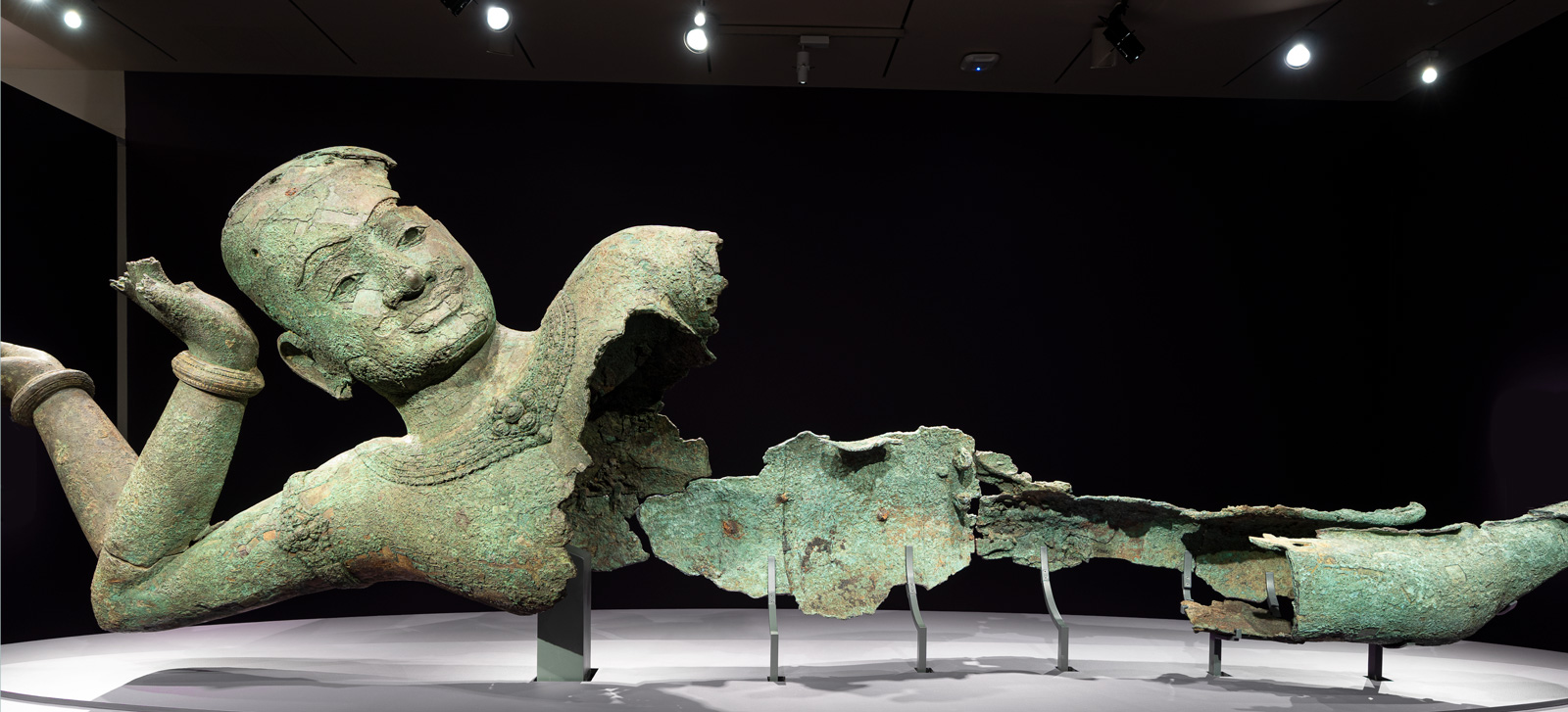
The Asian Art Museum in San Francisco has opened the first exhibition in its history devoted entirely to Cambodian art, built around a bronze so large and so storied that it spent centuries buried beneath a temple island. Vishnu's Cosmic Ocean, which opened on October 25, centres on the West Mebon Reclining Vishnu, a gilded bronze recognised as the largest ancient sculpture of its kind ever recovered in Southeast Asia. On loan from the National Museum of Cambodia, the work is the final stop on an international tour, and the museum notes that a national treasure of this importance is unlikely to travel again.
The bronze began its life nearly a thousand years ago, when it was cast to recline on a cosmic serpent above primordial waters on a man-made island in the West Baray reservoir of Angkor. It rested there, embodying divine power and prosperity, until it vanished from view. In 1936 a villager near the West Mebon Temple dreamed that the Buddha asked to be freed from confinement, and the dream prompted an excavation that recovered the sculpture from a shaft beneath the temple. Only about a quarter to a third of the original figure survived, a fragment of a form that once stretched nearly twenty feet.
The exhibition uses the bronze to tell a wider story about water, power and creation in the Khmer kingdom. Angkor's rulers tied sacred narratives to an extraordinary hydraulic system of canals, reservoirs, moats and embankments, and the show traces the sculpture from its casting in a royal foundry through its rediscovery and recent conservation. Maps, videos and interpretive displays explain how scientific research has revealed new details about its manufacture, including the astonishing quantity of molten bronze it required.
Curated by Natasha Reichle, the museum's associate curator of Southeast Asian art, the exhibition runs through January 25, 2027. A free talk, Calm and Chaos of Vishnu's Cosmic Ocean, takes place on November 1.