Art world report·Jakarta
Five-metre flowered cross for South Papua steals the quiet show at Art Jakarta 2026
A review of Art Jakarta 2026 (2–4 October, JIExpo Kemayoran) finds the fair's 'freedom and courage' theme embodied in works from a Thai water-lily series to a towering floral cross honoring Indigenous resistance in South Papua — as Indonesian galleries made up more than half of the 75-plus exhibitors alongside 33 international ones.
Art Jakarta 2026, held 2–4 October at JIExpo Kemayoran, leaned into a theme of freedom and courage — the red of the fair's key visual echoing, its reviewer notes, the same red as the Indonesian flag. More than half of the participating galleries were Indonesian, joined by 33 international exhibitors, and the fair reaffirmed its standing as a central pillar of the Southeast Asian art-fair circuit.
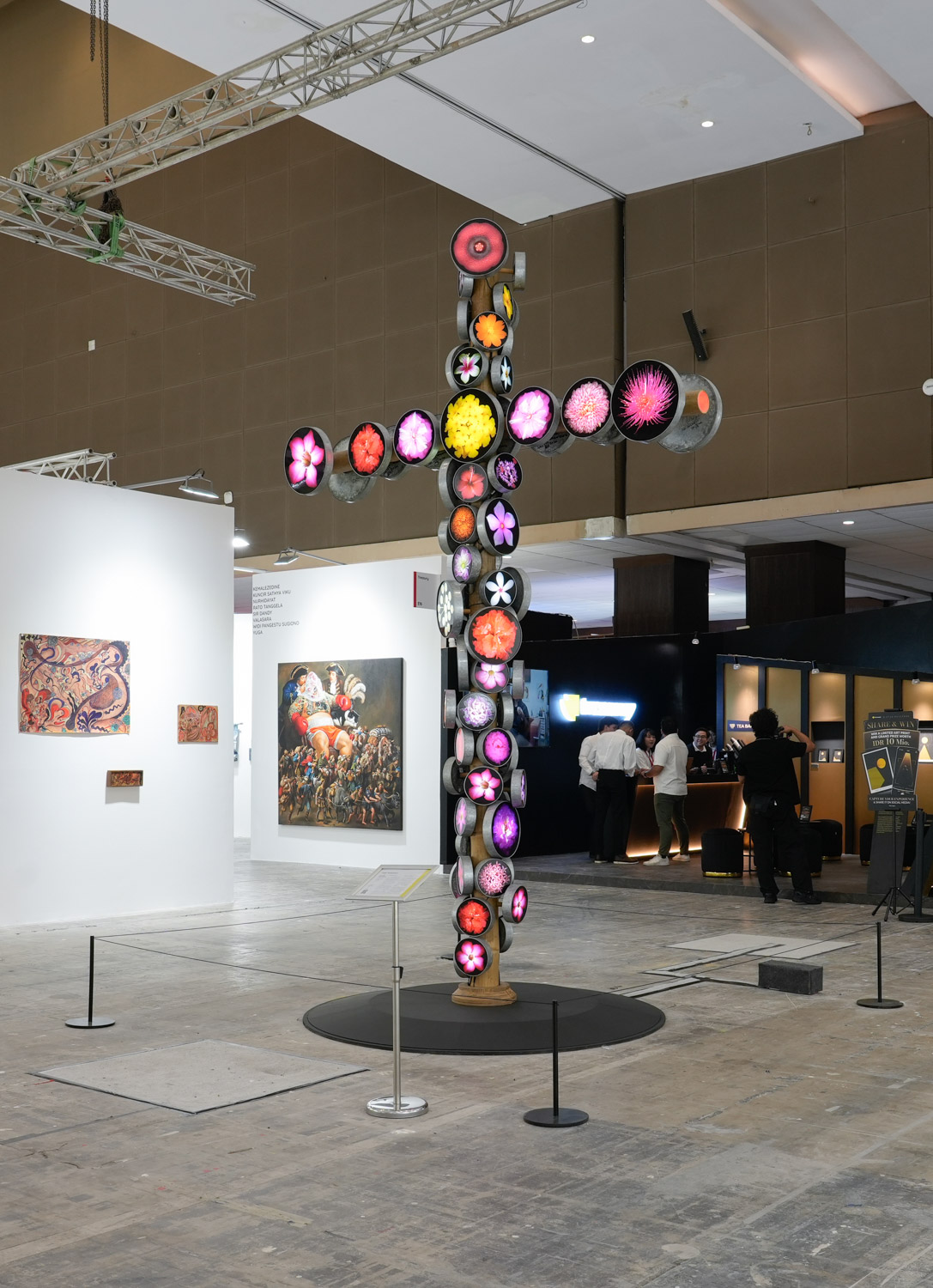
The most politically charged work stood in the SPOT section: Angki Purbandono's Berbunga-bunga, a tribute to the Red Cross movement in South Papua. The Yogyakarta artist built a roughly five-metre cross covered in flowers made from photographs, dramatically lit to draw crowds. The piece responds to a documentary about government megaprojects seizing Indigenous land and forests in South Papua; Purbandono drew on accounts of Marind, Yei, Awyu and Muyu communities erecting crosses in their customary forests as an act of resistance. The cross, he says, is a universal symbol of mourning and loss, while the native Papuan and Southeast Asian flowers serve as an offering honoring the communities' ongoing struggle.
Thai galleries made a notable showing. Taiwan's Artemin Gallery presented Butsapasila Wanjing's After Monet water-lily series, rooted in childhood memory with darker fears lurking beneath the surface. Warin Lab Contemporary centered its booth on Mutation, a collaboration between Sakarin Krue-on and Jarupatcha Achavasmit, while Kanokwan Sutthang's new small plant-life works sold out during the VIP preview. An ara contemporary presentation included an obelisk-form mixed-media work depicting the events of Indonesia's independence struggle against Dutch colonial rule.
Beyond the booths, the fair's special sections — SPOT, SCENE for collectives and collaborative projects, and AJX for institutional collaborations including a Korea Focus — underscored how the fair functions as both market and stage: a place where transactions sustain artists' careers while narratives from distant forests to colonial histories reach the fair floor.